Lesson inspired by Vincent Van Gogh’s painting “The Starry Night”.
****Updated with new pics on Tues. 10/24/17****
On day 1 of the lesson, students looked at a slideshow of Van Gogh’s paintings and learned about his life and artwork. We took a close look at his painting “The Starry Night” and noticed that he used lots and lots of short lines painted close together in certain directions, to create a sense of movement!
Then students got to work creating their own Van Gogh inspired masterpieces with a pumpkin!
Students followed along with me for the first steps, as I demonstrated under a document camera. (Photos below)
They traced a pumpkin using a cardboard cut-out along the bottom of their 12×18” tagboard paper. Students held their paper vertically rather than horizontally, so they would have more room on their paper to create the starry night sky.
Students then drew a line for the ground, a crescent or full moon ( a banana shape or a circle) and small circles for stars with pencil. They then drew straight lines in the pumpkins stem, and curved lines inside the pumpkin.
Students then took both a yellow and a green crayon in one hand and drew lines using both colors at the same time, all along the bottom for the grass making sure to press really hard as they drew.
They colored in the moon and stars with yellow, and outlined all the lines within their pumpkin and stem with whatever colors they wanted, making sure to continue pressing hard.
For a final step with the crayons, just like Van Gogh did with his brush, students drew lots of short dashed lines with yellow, circling all around each star. Then with blue crayon drew more dashed lines all throughout the sky curving around their stars to create a sense of movement!
Below are photos of students hard at work creating their masterpieces!!!
On day 2 of the lesson, students painted their pumpkin, grass and sky any color they wanted using concentrated liquid watercolor paint. I LOVE liquid watercolors —they’re SUPER vibrant and saturated! By far, my favorite paint for art lessons! (A little bit trickier for prep and clean up, but well worth it!)
A lot of you art teachers out there might think I’m crazy– but I don’t dilute the paint. Only if the paint comes out of the bottle like syrup would I add a teeny bit of water (like about 1 tablespoon *or less* per little cup of liquid watercolor paint). The ones I buy are Sax brand and lately it’s been hard to find online, as many colors are out of stock. The yellow is really the only one that I add a bit of water to, since I find that color is for some reason the most syrupy in consistency.
The only rule with color I had was that they had to paint their pumpkin, grass and sky each a different color. That way they would each stand out from one another.
*Skip this next paragraph in bold if you’re not an art teacher or not interested in details about paint and art teaching stuff*
I find that concentrated liquid watercolors can be tricky when trying to see the actual color in the cups due to their intensity. Red, orange, and magenta can all appear to be the same when just when looking at it. So what I have kids do is **GENTLY** take their brush (and I demo this part under a doc camera) and after dipping it in the cup, slide it up the side of the cup and look at the color dripping down the edge back into the cup to see. It seems to do the trick. I might label each cup by color with tape and sharpie next time to make it even easier. Not sure how long the tape would hold up…maybe writing it directly on the plastic cups would be best but sometimes I use the cups for other things.
The cups I’m referring to are from Tide laundry detergent caps….and they are awesome to use!! They are stackable, hold up with wear and tear because of the thickness of the plastic, are just the right size, and rinse out easily! Plus– this way I can pour any leftover paint into individual bottles!
Anyhoo…….While painting, students learned about the technique crayon wax-resist. They all loved watching the paint glide right off the crayon parts and thought it was pure magic!!!!
On day 3 of the lesson, students went over their moon, pumpkin, and 5 circles for stars with glow in the dark three-dimensional puffy paint! We talked about how the puffy paint adds texture and will pop out from the paper. Students obviously LOVED this step although I must admit, I was a little nervous on how this would all work out! They did a really good job! …. other than a few kids “forgetting” to only add puffy paint to the few areas I told them! Students then watched a quick 7 minute animated video on Van Gogh when finished!
Some finished work with glow in the dark puffy paint!
I can’t get over the VIBRANT colors these paints have!! I love how each one turned out!!
Here’s some fun close-ups of the texture we added with puffy paints! Kids L-O-O-V-E-D this step!
In the photos below, this class used tempera cakes to paint rather than liquid watercolors because I didn’t receive my paint order in time, but they still came out vibrant!
I can’t wait to display them in the halls!! I love them ALL!!
MY NEXT POSTS WILL BE TOMORROW AND THURSDAY NIGHT (10/25 & 10/26) WITH NEW FINISHED ARTWORK FROM SOME NEW ART LESSONS—1ST AND 3RD GRADE—- AND 2ND GRADE ABSTRACT SELF-PORTRAITS!!
Special needs students created these gorgeous pumpkin collages using liquid watercolor, tissue paper, glue, and liquid tempera paint!
On day 1 of the lesson, students traced a pumkin using a cardboard tracer onto 9×12″ 70# or 80# paper. They then glued on orange, red, yellow and pink squares of pre-cut tissue paper using a paintbrush and watered down glue. They brushed on a second layer of glue once a piece of tissue was placed on. They used a brown piece for the pumpkin’s stem.
On a second sheet of 12×18″ heavyweight tagboard paper, students painted a turquoise sky with concentrated liquid watercolor paint.
On day 2 of the lesson, students cut out their pumpkins and glued onto the sky painting using a glue stick. They then glued on cut strips of various green and yellow tissue paper for the grass using watered down school glue and a paintbrush.
For the final step, they sponged on leaves in the sky by lightly dipping a pre-cut sponge in the shape of a leaf into a plate of drizzled red, yellow and orange liquid tempera paint, then gently pressed onto the sky to create falling leaves!
In the beginning of every year I have all my students create their own sketchbook, that will be used periodically throughout the whole year.
Each grade has a different drawing lesson to create a cover for their sketchbooks. Sketchbooks will be used to free draw in if kids finish a lesson early, to practice drawing before creating a final version for a lesson, to copy down information that they’ve learned about a particular lesson, and to experiment in with various art materials.
5th grade – Superhero Sketchbook Covers
5th graders looked at a variety of superhero comic book cover illustrations and then came up with their own unique superheroes demonstrating their superpowers. They had a choice of creating sidekicks, whether they wanted to include a villain and created a background scene. Drawings were then outlined in black sharpie and colored in with a choice of marker or colored pencil or both.
I love this drawing lesson because it allows so much creativity! Each one is so unique!
AS YOU’LL SEE BELOW, SOME STUDENTS ARE STILL WORKING, BUT COULDN’T WAIT TO SHOW THEM! I WILL RE-POST THEIR FINAL VERSIONS ONCE COMPLETE LATER.
STUDENTS FILLED OUT A WORKSHEET ON THE FIRST DAY TO PLAN OUT THEIR IDEAS FIRST.
PHOTOS OF 5TH GRADERS WORKING ON THEIR SUPERHEROES!
***To view superhero sketchbooks from previous years, click on the menu button and select 5th grade art lessons and scroll down.
Up next!!!…..OP ART 3D CONE DRAWINGS!
4TH GRADE – INITIAL DESIGN WITH ANALOGOUS
COLORS
For this lesson, students created a tracer of their initials from manila tagboard using block letters. Students could draw their letters on the tagboard either stacked on top of one another, side by side, diagonally, and could flip them backwards.
Once cut out as one piece, they traced their initials at least 8 times, creating an interesting design and went over their lines with black sharpie.
They then drew a background design with pencil, and colored in only the background with markers using analogous colors, leaving their initials white so they popped from the colorful background.
PHOTOS OF 4TH GRADERS WORKING ON THEIR ARTWORK!
UP NEXT!…… VICTORIAN HOUSE DRAWINGS!
3RD GRADE- ART TOOL SKETCHBOOK COVERS
Third graders chose 1 art tool (they could choose from: scissors, hole punchers, staplers, tape dispensers, foam rollers, glue bottles, or paint bottles) and created observational drawings of their chosen tool from 4 different viewpoints (from the top, from the bottom, from the side, and from the front). Kids could also draw additional drawings of their tool once the 4 viewpoints were drawn and could draw some of them coming off the page or overlap some.
Once drawn in pencil, they outlined in sharpie and colored in using marker or colored pencils, or both.
3RD GRADERS WORKING ON THEIR ART!
(Students are currently working on their “Finish the Picture” lesson)
UP NEXT!…..DAY OF THE DEAD SKULL DRAWINGS ON TINFOIL!!
2ND GRADE- WARM/COOL HANDS WITH PATTERNS
Second graders created a drawing of their hand with patterns inside their hand and in the background and then colored in using warm colors inside just the hand and cool colors only in the background (or vice versa) with marker.
This student is still coloring in, but is doing such a fantastic job had to post it! Nice work Milo!
(2nd graders are now working on their “Abstract self-portrait paintings!”)
UP NEXT!….MONET INSPIRED MIXED-MEDIA 3D WATER LILY
1ST GRADE- LINES THAT WIGGLE DRAWINGS
First graders listened to the fun story “Lines That Wiggle” by Candace Whitman. We then looked around the room and did a line scavenger hunt with our eyes!
Students drew at least 8 loopy, overlapping lines with pencil. We talked about how it kind of looked like a rollercoaster! We also discussed how when lines connect, it creates a shape! Students then outlined all their lines with black sharpie, and colored in each shape created with marker!
(1st Graders are currently working on their “Pumpkin’s Starry Night” lesson inspired by Van Gogh!)
UP NEXT!….. “NOT SO SCARY SCARECROW” COLLAGE!
I am SOoo excited because I have SO many NEW awesome art lessons planned for the year that I KNOW the kids are going to LOVE!!
I cannot WAIT to get started on them! (There will be least 1 new lesson per grade) and can’t wait to show you!
Of course many of my previous art lessons will still happen because they are keepers and students love them as much as I do!!
Some new ones will start right away and some are coming up later on the year!! Stay tuned!!…..❤️
A wee bit late posting this…. I created a little photo op spot in the gym during open house at Roosevelt School (which was almost two weeks ago!) But O-well! Better late than never right?!?
I thought it’d be fun to create a fun, silly photo opportunity for kids to strike a pose for that evening, while parents went to their children’s classrooms! Kids were playing basketball too, so it was kind of a crazy space to try to photograph– BUT…even amidst all the craziness and chaos with balls flying everywhere the kids had fun!
I made a giant frame from foam board, cardboard and model magic, a quick splatter paint backdrop, a couple of speech bubbles, as well as painted giant paintbrushes and a paint palette for props. There weren’t too many kids that night but the ones that did come with their parents (or ones that were hosting a table with info. for parents) had a blast posing for a quick pic!
First graders are continuing to learn more about the element of art line in ART! (More photos below of close-ups and of kids creating their sculptures!)
They created 2 of each of the following (curved, zig zag, and curly) to create these awesome three-dimensional paper sculptures!
They also learned that they created their sculptures focusing on 4 of the 7 elements of art(line, color, shape, and form) and how ALL artwork in the world is created using at least one or more of these elements- And that 3D artwork means artwork that isn’t flat and sticks out and that sculptures are 3D!
Students did such a fantastic job creating these line sculptures! They got really creative and glued pieces on top of other pieces and created their own lines as well!!! I love how they look all assembled together on the wall too! Thank you Cassie Stephens for the lesson idea!
Be sure to read the previous post below! Super fun glow in the dark pumpkin painting lesson for 1st graders!!
Follow me on Instagram @mammalovespeaches for more student artwork and lesson ideas!
I’m so excited to start this lesson with my 1st graders!! They are going to FLIP when they find out they’ll be using glow in the dark puffy paint!!!
Here is a quick time lapse video of me adding the final touches to one of my teacher examples.
First graders will begin this lesson after they create 3D paper line sculptures!
I’m even considering buying a black light to hang kids art under in the case at school! However, I’m not entirely sure if the additional halogen lighting in the area where it will hang will affect the glow?????, so if anyone out there knows about this—please let me know if it’s worth doing!
This lesson is inspired by Vincent van Gogh’s painting; The Starry Night. Students will learn about Van Gogh and his artwork and how he used lots and lots of short lines close together in certain directions, to create a sense of movement. The puffy paint adds texture, like Van Gogh did with his paint in his paintings. Plus it’s just so darn fun, kids will go crazy over it!!
Last year I did this exact lesson but without the addition of puffy paint. To learn more about this lesson click on 1st grade art lessons under the main menu and scroll down!
Follow me on Instagram (@mammalovespeaches for more student artwork and ideas)
My special education classes just finished their super cute leaf bird collages inspired by Art with Mr. Giannetto (via Instagram)! Thanks for the idea Mr. Giannetto!
On day 1 They glued strips of brown paper for branches, applied yellow painted dots with their finger, and added leaves using crumpled tinfoil dipped in green paint.
On day 2 They glued their leaves for the birds body, added a triangle for a beak, and googly eyes and a feather to complete their collage!
Since the second part was only going to take a few minutes, we started another art lesson for the remaining time in class.
They stamped black lines and circles using cardboard and a plastic cup on 12×18″ paper. We talked about horizontal, vertical and diagonal lines as well as shapes (in this case; circles) and overlapping lines and shapes.
We looked at Kandinsky’s abstract artwork for inspiration.
In the following art class we will add paint to the shapes created to finish our masterpieces!
I teach 2 special education classes at one school in my art room and 1 class at another school off a cart. The classes are small (usually up to 4 or 5 kids) with AMAZING paraprofessionals that assist them while they create. Their ages can range from 1st-5th grade and they have varying physical and mental challenges.
When I plan lessons for these students I think about their ability and what they will feel successful at, what can I have them work on to improve their fine motor skills, speech, social skills, emotional processing and of course, what they will enjoy! A lot of the lessons are tactile, which are especially nice for my hearing impaired and visually impaired students.
Modifying the tools and techniques are important for these kids. Sometimes the para’s bring in special equipment like small easel boards that can mount onto the wheelchair or special sized scissors or electric cutting tools. I also offer large handle paintbrushes, wide pencils and sometimes have things pre-cut or use tracers to help them draw and collage together. Smaller items to glue or alter (like bending pipe cleaners for instance) also help students develop their fine motor skills.
Most of my students I see year after year in the same class…which makes it a bit tricky coming up with new lessons every year for them. Especially since most lessons are 1 day projects (at best, 2 day projects). I sometimes repeat lessons that are just way too awesome not to, but I try to switch up the art lessons so they don’t bring home the same projects year after year. That way they are learning new art concepts and techniques AND creating new art each time too!
I get so many awesome ideas from my fellow art teachers in my district, (love you guys!!) fellow teachers on Instagram, art teacher blogs, as well as on Pinterest. Oftentimes I’ll see a lesson for kindergarten or 1st grade and just modify it a bit. A BIG thanks to EVERY ONE of you AMAZING art teachers out there sharing your awesome lessons!! It’s so wonderful and helpful to have those great resources! I hope that my lessons help you out as well!
If you teach special needs kids too, what are some of you’re favorite art lessons?
Please respond by clicking on “no comments” directly under the title of this post or “comment” if someone has already commented.
To view previous student artwork with lesson descriptions for special needs scroll under my menu on the main page and select special education!
Some of my favorites I’ve taught are shown below! (all photos are of student artwork only)
Follow me at mammalovespeaches on Instagram for more elementary art lesson ideas!
Here’s a quick video of my students having fun moving dots on their interactive, collaborative dot display, hung up in the hallway, inspired by the book “The Dot” by Peter Reynolds!
The interactive, collaborative dot display was created by my 2nd, 3rd and 4th graders.
On the first day of art, students played a fun, collaborative art game called “Roll with it” (I discuss this in more detail in a previous post).
Students rolled dice and whatever number they rolled, they were instructed to draw certain lines or shapes using whatever color they wanted with marker. ( I posted a list of what to draw according to what number on the whiteboard so everyone could see).
After drawing, they passed their paper to the person to their right at their table. They continued rolling the dice drawing and passing, eventually creating an abstract picture.
The papers were then hole punched with a large hole puncher and assembled together, creating one giant dot, with velcro adhesive on felt boards. Each grade had their own dot panel (2nd had the red panel, 3rd had the yellow and 4th had the blue panel).
Students learned about the 7 Elements of art (line, shape, color, value, form, texture, space) and that ALL artwork is created using at least one of these elements!
They also learned about collaborative art, and interactive art! The panels are currently hanging in the 2nd and 3rd grade classroom hallway by the cafeteria.
Students and staff can interact with the art and move the dots around creating new images and shapes on the other orange, green and purple panels! As you can see in the video above, kids had so much fun interacting with their artwork!
Artwork inspired by the book THE DOT by Peter Reynolds and International Dot Day (September 15, 2017)
5th Grade
On the first day of art for 5th graders, students had a blast creating “Paper Towers”! Below is a time-lapse video I took of them creating!
Students at each table were a team and had to build the tallest paper tower using only 20 sheets of newspaper and 1 roll of masking tape. They had 5 minutes to brainstorm ways to create their tower without touching the paper or tape, then had 10 minutes to construct their towers. We talked about how it’s more about working together as a team rather than winning. Kids had so much fun creating them and worked well together as a team!
1st Grade
On the first day of art for first graders, kids participated in a quick art lesson I called “What do YOU see?”. I read them the story Beautiful Oops by Barney Saltzberg, then each student received a paper that had a random line or shape drawn on it (or both lines and shapes) and they used their imagination to create something out of it. The black lines drawn in sharpie were the original lines given. They did a fantastic job using their creativity and came up with some wonderful images!
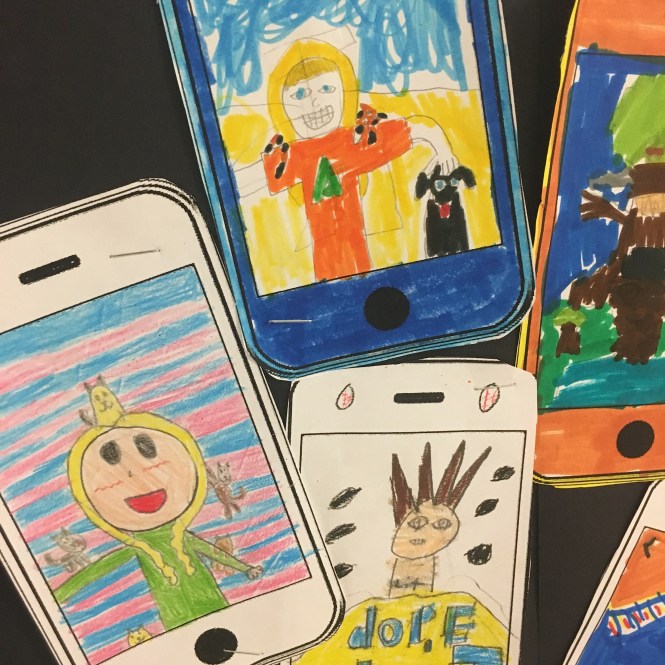
My 4th grade classes just finished up a quick 1 day art lesson on their 2nd day of art, creating self-portraits drawn inside a cell phone. I saw the idea on Instagram from another art teacher- thank you Katy Hanson for the idea!!
This week, ALL my classes started their sketchbook cover drawings. I have all my students create their own sketchbooks in the beginning of every year, and each grade has a different art lesson creating a different drawing for their cover!
1st graders learn about line, and after reading the book Lines That Wiggle, they draw overlapping loopy lines and color in the shapes the lines create, 2nd graders create a warm/cool hand with patterns, 3rd graders create a drawing of an art tool showing 4 viewpoints of their chosen tool, 4th graders create a unique design using their initials and analogous colors, and 5th graders create a comic book cover style drawing and create their own unique superhero!
I’ll be posting more on these and others soon! Thanks for visiting my blog!
Ahh…… kids favorite topic to listen to—The art rules and routines. You know the drill– its not super fun to have to go over them, BUT it has to get done.
I thought I’d share with you how I implement my art rules and routines in the beginning of the year. I’m sure you all do a ton of the same things that I’m going to mention, but maybe a couple of them I do differently and might be of use to you!!
So hear goes…
I’m going to apologize in advance. It is A LOT of text, (I’m not gonna lie) (insert worried expression emoji) but I do discuss in detail about each, and also discuss consequences for some of them as well. Plus, did I mention, I’m new to this blogging thing???
I am sharing this because hopefully some of it will be of use for some of you AND I’d love to hear your feedback and suggestions as well!!! So please comment!
THE STAR CHART / MY ART RULES
CLASS STAR CHART ON THE LEFT—-ART ROOM RULES POSTER ON THE RIGHT
The star chart is a positive reinforcement tool for students to earn points (or in this case, stars) as a class, in order to earn a “choice day” in Art. (More on what choice day is below)
Each class has their own STAR chart, labeled with a sticky tab on the side to easily flip pages over to that particular class (this pic above doesn’t show that, since it’s an older photo when I somehow hadn’t thought of that sticky tab class locator yet). It’s funny how simple stuff like that doesn’t occur to you until much later!!
But, I digress….
Each letter in the word STAR represents a behavioral expectation while in art: I expect students to be safe, thoughtful, accepting and respectful. I go over what each one of those behaviors looks like to kids with examples.
SAFE: meaning students are showing safe behavior with tools and materials, and their bodies.
NEVER throw things
NO running in the classroom
Hands to your self
Sitting in chair correctly
Using art room tools and supplies correctly
THOUGHTFUL: Simply…think of others. Students are being kind and considerate of one another. Some examples;
A student helps another student pick up some spilled paint without being asked
Always shares art supplies without a problem
Helps a friend find a glue stick/marker they dropped
Encourages someone if they see that they’re upset
ACCEPTING: Students are accepting of each other’s artistic and personal differences; Understand that we are all unique and have different ideas, and that it’s good to be different.
Use only positive language when talking about other people’s artwork
NEVER say anything mean about each other’s artwork or about each other in general
RESPECTFUL: Students are respectful towards the teacher, each other, and the art room materials.
Listen to the teacher when she’s talking or giving directions/ NO talking during this time
Listen to others while they are talking
Using an appropriate voice level
Raise your hand if you have a question
Never draw on someone else’s artwork or hurt someone else’s artwork
Take care of the art supplies
Stop working and clean up when it’s clean up time
Give each other space when working and lining up
Students are expected to show star behavior during art.
At the end of every art class, (while they are sitting at their tables before they line up to leave), I share with students how I thought they did as a class for each category.
They can earn 1 star under each category, and up to 4 full stars per art class.
If I witnessed behavior that eh, wasn’t so great… they earn a half star or NO star under that particular category. Once they reach 30 stars in total ***(2) -1/2 stars equal a full star when tallying*** the class earns a CHOICE DAY in the following art class.
CHOICE DAY allows kids to sit where they want, which obviously kids love! AND they can choose what to work on in art for that day! They usually have at least 4 choices of what they can do, (this can include: free drawing in their sketchbooks, reading art books, painting, modeling clay, scratch art, collage etc,) depending on what materials I have available that day.
Once choice day happens, the class starts over on a new chart the following art class. Classes typically earn 3 choice days a year.
Kids really love going over the star chart at the end of class, and look forward to earning their choice day! I really do see positive results from implementing it, so it’s a definite keeper in my daily routine!
STUDENTS ARRIVAL / SEATING CHARTS
When students arrive to class they sit at their table spot. I have name cards pre-made that are on tables where each student sits.
The cards are used only for their 1st and 2nd art class.
I have 4 tables that are color coded (red, blue, yellow and green) with 9×12” laminated colored construction paper in the middle. That way, they last longer than regular paper, and they can be easily moved if they get in the way or to wipe tables.
After the first art class I create a seating chart based on how I think the day went with where the kids sat.
On the 2nd day of art, students walk in and find their name tags again, (might be in a different spot than on day 1) and from there on, I just ask that they remember where their spot is. (If anyone is confused down the road, I can whip out my seating chart and show them!)
So by the 2nd art class they have permanent spots for the year. Of course, if I think kids need to move, I may change their spot at some point and let them know and make adjustments on my chart. Students are expected to sit in their spot and can only move if they ask first.
TRANSITIONS/ ATTENTION GETTING/ CLAPPING
After kids are seated and I’m ready to introduce the lesson or continue with directions for the day, I clap the school clap, which is used district wide. Students know to respond by clapping the same clap back and look and listen.
If they don’t all respond, I repeat it and wait until everyone claps back and shows me they are ready and listening. If it’s a difficult day and kids aren’t showing me they’re ready, I sometimes have them get up and line up in the hallway, and re-enter the art room and sit down all over again…. the correct way.
LISTENING DURING INSTRUCTION (Powerpoint presentations/ goals & directions)
As you all know, listening during instruction is a BIG one. It’s a teacher’s number one pet peeve if a student is clearly not listening– or worse– chatting with another student! If I see that some kids aren’t listening or aren’t watching what I’m doing, I say to the whole class, “make sure you’re paying attention! If you aren’t listening to what I’m saying, you’re not going to know what to do”. That often does the trick. Sometimes I’ll walk over to that particular student and just by standing near them, as I am talking, their attention gets re-directed.
Also pointing out the students who ARE modeling good behavior to the whole class often makes others want to do the same. For instance, I might say something like, “I really like how Jackson and Sarah are doing an awesome job of listening and following directions! They’re showing me that they want to learn about X,Yand Z”!
*This next one is a little off topic, and more to do with my TEACHING routines— but– I wanted to discuss it anyway because it might be something you’re interested in.
For ALL my lessons, I project a Powerpoint on the whiteboard that includes artist’s examples, examples made by students from previous years, my teacher examples, sometimes videos, and the lesson’s goal and directions.
Here’s an example below of one of my powerpoint pages on finishing up self-portraits for 3rd grade
And another one for a different lesson for 3rd
Showing a Powerpoint is SOOO much easier than hanging up multiple examples for kids to see, writing directions and lesson objectives by hand on the whiteboard, THEN having to erase everything for the next class.
Once created, I use the same Powerpoint again and again year after year. And if I want to make any changes, it’s super easy, then just re-save it. I have everything saved on my flashdrive.
Plus it’s super convenient, since I’m a traveling teacher and teach between 2 schools (one of which I teach from a cart). All I have to do is pop in my flash drive in the teacher’s computer and away we go!!!
I do however always have my teacher examples to hang up on the board as well as project directions and goals. That way, when directions and goals are projected- the artwork examples are still visible for students.
Ok, sorry, I think I got a little off topic, but figured I’d share that tip if you don’t already show powerpoints or other slideshow presentation methods, which I’m sure most of you do!
VOICE LEVEL/ PAINT PALETTES
Students know that they can talk during art making time, but that it needs to be at an indoor volume. Not recess volume. The signs face out spelling “ART” until I think the class is getting too noisy. If it’s too loud, I clap to get their attention, they do the same clap back and I explain that it’s too loud and I’m going to flip over the “A” to warning #1. If at some point it gets too loud again- I repeat clapping and tell students to quiet down again and flip over the “R” to warning #2. Students usually know I mean business when this happens, and quiet down.
If I have to clap a 3rd time, I flip over the “T” and the whole class has a silent art until the end of art. This definitely happens on occasion.
Students know the consequences if they repeatedly get a silent art: One or all of the below can occur:
Earned stars can be taken away from the star chart
Classroom teacher is notified
The following art class is a silent art the ENTIRE time
Recess time gets cut short (or students have to stay outside with everyone else at recess, but not allowed to play for a bit)
I always stress to them that I hate doing those things, that I certainly don’t enjoy it. BUT– if they can’t be respectful of other classrooms around us, and work with an indoor volume, they have to understand there will be consequences.
RAISING HANDS TO TALK
OK, this is an obvious one. Students shouldn’t blurt out when a teacher is talking. They are expected to raise their hands and wait to be called on. But, I often get a lot of hands up even BEFORE I explain anything once they sit down. Sound familiar?
My response is, “Is your hand up because you have an emergency or do you have a question about the lesson?” If it’s about the lesson, I say, “I’m going to get to that in a minute, just listen for now, and if you have any questions or comments afterwards, I’ll answer your questions or you can share then”.
Not a big deal, and that usually solves the issue.
HOWEVER, if students are continuously being a distraction or persistently shouting out during instruction, I first of all calmly remind them they need to stop shouting out, and that doing so wastes everyone’s time AND that it’s affecting their classes star chart.
Students know that there are consequences if I have to speak to them more than 2 times for this behavior. These can include any or all of the below:
Student moves to another table (away from the other students)
Can only come back to their table spot when they look ready and can follow directions
I pull the student aside to speak with them privately
Discuss behavior with their classroom teacher
Ask them to take a break (get a drink of water across the hall, or help bring finished artwork to other classrooms –depending on the student)
Fill out a behavior reflection worksheet (found on Pinterest)
PASSER OUTERS/ STUDENT HELPERS
I know this is another obvious one, and a lot of you do this as well, but I thought I should include it since itisa routine.
Students raise their hands if they want to help pass out art materials
I choose 3-5 helpers (depending on the lesson and how much stuff needs to be passed out)
In the beginning of the year I explain/remind kids where everything is located as well as have the areas labeled
Students get the art materials and pass out (thus helping students remember where the art supplies are in the room)
Jobs help build self-reliance, a sense of community and trust in the art room
ART SUPPLIES/ LABELING ART SUPPLY AREAS WITH PHOTOS
I discuss respecting and taking care of art supplies when I go over “Respectful” on the STAR chart. Students are expected to put things away where they belong, (put marker caps, glue caps etc, back on tightly, put paint brushes bristle side up, erasers and pencils in their table bins, etc.)
I haven’t done this yet, but I plan on taking photos of the way things should look when art supplies are put back on shelves or in bookcases, then laminating those photos and taping them up in those particular areas.
Sometimes I find kids will try to shove (and somehow get them in there?!) 3 bins stacked on top of each other… when only 2 will fit. Hoping having these reminder photos will help solve that issue!
THE DEMONSTRATION TABLE
(not a great pic- but it’s all I had….pictured below with the blue chair)
Students are called up by table color (one table at a time, /quietest table first)
NO talking once around the table
Hands are off the table
This table also serves the purpose of moving students to work quietly alone if needed and at times to put art supplies on
I have done this method for the past 3 years, but THIS year I will be getting a document camera (which I am soooo excited about!!!!!!!!!!!!) So kids can just stay in their seats and watch on the whiteboard while I demo under the document camera. This is going to be a GAME CHANGER for me for sure! No wasting time waiting for everyone to get to the demonstration table, no kids saying “I can’t see!” and leaning in too far!
I cannot wait to start using it!!!
THE “WHAT SHOULD I DRAW?” JAR
Inside this jar are strips of paper with various silly and fun drawing prompts that I typed up.This is how it works.
If students are finished early and have checked in with me, they can pick out ideas from the jar
Students pick 3 slips of paper blindly from the jar, bring them back to their seat and choose 1 or 2 to draw in their sketchbook
Comes in handy if students have a hard time coming up with an idea when they have free time after finishing up their artwork, OR if they earned a “choice day”…… Kids LOVE it!
HERE’S SOME EXAMPLES OF MY DRAWING PROMPTS……
ART BOOKS/ ART LIBRARY
I’m slowly growing a pretty good size book collection in my art room! I love ordering/finding cool art books! (If you have any great ones YOU love for your class—-comment below!!!) I want to know about them!!!
If students finish their artwork early they can ask to pick out a book to read at their table spot
Kids must clean up their table area first if it’s messy with paint, or glue or something that might damage my books
Are expected to put the book back neatly when finished reading
BATHROOM SIGN OUT
Pretty self-explanatory
Students have to ask first so I know that they have left the art room
Students must sign their name on the dry erase board then erase or cross off their name when they return
CLEAN UP ROUTINE
Oh, dreaded clean up time!! EVERY ART TEACHER’S FAVORITE TIME. Wouldn’t it be AMAZING if we could just wiggle our nose and everything would- –poof!- be put away and tidied up like nothing even happened!?! HAHA
Here’s my clean up routine. This might not work for you or your classroom, but it’s been working like clockwork for me.
I always clap at least 5 minutes before the end of art to let kids know that it is clean up time. 5 minutes is a MUST for clean up. If it’s a pretty messy lesson that day (painting, collage, lots of art materials out …YOU KNOW HOW IT GOES ) then I allow for more clean up time (like 8 minutes).
Just like the art and supply passer outers in the beginning of art, I ask kids to raise their hand if they would like to be clean up helpers.
This can include: artwork collectors, art material collectors, art tool collectors, table wipers, floor checkers, and floor sweepers. It really just depends on the class’s lesson. I usually pick about 3-4 helpers while everyone else stays in their seats.
In the past I’ve tried having each student clean up their own area and putting their own stuff away, but I found that it was sometimes confusing for students as to what they were supposed to be in charge of –particularly if they shared things (a marker bin, water cups, paint trays, colored pencil bin etc.) If they are all using it, who’s in charge of putting it away?
Also I feel that there are too many people moving around the room if kids are in charge of their own mess. I think by picking out a few students as clean up helpers, each student can focus on that one specific task, and it gets the job done quickly and efficiently. But, that’s my clean up routine, and if you disagree, whatever works for you- works for you!
After cleaning up, we wrap up the end of art by going over the star chart, and then it’s dismissal.
DISMISSAL PROCEDURES
Students are expected to remain sitting quietly at their table spot after the star chart
Students wait for their table to be called to line up
Tables are dismissed one at a time
Students are expected to quietly walk to the door and line up giving each other space
If time allows, I’ll quickly let students know what we’ll be working on in the next art class. If there is extra time or a teacher is running a bit late to pick up the class, I’ll do a quick pop quiz with them while in line!
I either ask questions about what they learned that day or what they’ve learned in previous years.
For example, “Who can raise their hand and tell me what the complementary colors are?” or “What was the artists name we learned about today?”
So there you have it…..
Rules and routines are SUPER important in art. I don’t want to even imagine what that might look like if there weren’t rules and routines in place!
I think the most important thing is— find what works best for YOU and YOUR classroom (or cart!) and make sure it’s consistent. You can always modify these rules and routines over the years, especially if you see that what you have in place is not working so well, (and hey, I know I am in the process of examining my own right now and might tweak some stuff here and there).
My goal is to constantly GROW and LEARN as a teacher (whether its through my own mistakes, or learning from watching others, reading about other methods) but basically… constantly striving to IMPROVE for our students to create a positive, supporting, fun atmosphere.
Hopefully some of this was helpful for you and your class! Or at the very least interesting to read!
If anyone would like to comment, make suggestions, or share your art rules and routines I’d love to hear it!
NEXT UP!….. SHOULD I BLOG ABOUT TEACHING FROM A CART OR ART ROOM ORGANIZATION?
Found this old gem last night in an old flashdrive that I thought was lost forever!
(make sure your sound is on!)
I created this stop-motion animation with 5th graders when I was student teaching in 2012. I had groups of 3-5 kids join me in an area of the classroom to draw while I took photos. The art teacher would stay with the rest of her class working on another lesson while I called groups of kids up to the “animation station”.
Students brainstormed ideas first, planned out their ideas as a team, then would draw little by little with dry erase markers on a small whiteboard that I had. I snapped pics of each small change in their drawing.
The dry erase markers made it easy to erase parts and then add on. Once finished, I uploaded the images in my personal computer and I edited them together in iMovie.
Later, the kids created music with the music teacher and she added it to their animations!
It was really fun and was shown during a school assembly at the end of my student teaching.
I would LOVE to try doing stop-motion again with my own classes this year, but not sure how to go about doing it. It’s a little overwhelming thinking about the equipment I’d need, time, cameras, tripods, computers, computer software, using the computer lab, and juggling the amount of students working on a project like this….you get the point. I know our school has iPads so I think I could figure something out, but the whole idea of setting iPads up for multiple kids in multiple classes, and planning something like this out is a little daunting! If you have any suggestions for me I’d greatly appreciate it!!!
Best,
Mollie
Follow me by subscribing! Add your email to the subscribe box to the right in the sidebar!