NEW ARTWORK BY 1ST – 5TH GRADE!!

Each grade level has finished up another art lesson (or two!) since I last blogged, so…. I figured I’d just write a HUGE blog post on ALL grades!

I hope you enjoy reading and looking at all their beautiful artwork and fun photos of students creating them!! There’s a TON of photos!

Here we go!…..

1ST GRADE

MIXING PRIMARY COLORS TO CREATE SECONDARY COLORS!

In this quick 1 (40 min.) art class, first graders learned that the primary colors on the color wheel are red, yellow and blue. They also learned that these 3 colors cannot be created, and that they already exist! BUT if they are mixed in a certain way, they create the secondary colors (purple, green and orange)!

After demonstrating under the document camera on how to mix the primary colors, students each mixed on their own practice sheets.

They used liquid watercolor paints to mix within the circle on their worksheets. They loved seeing the colors appear like magic! And seeing their water cups change colors as well as they rinsed their brushes!

After creating the secondary colors, students watched a couple of fun, short stop-motion videos about the primary and secondary colors as seen below! They absolutely LOOOVED them and I think the jingle helps them remember better! They wanted me to play it a few times!

LOVE IS IN THE AIR! – 1ST GRADE

This fun 3 day lesson incorporates the elements of art; Shape, Color, Line, Form, and Texture! We also review overlapping, and crayon wax resist painting throughout the lesson.

Kids finished them up just in time before Valentine’s Day! I can’t wait to display them in the hall!

DAY 1: CREATE THE WARM TISSUE PAPER BACKGROUND

Students glued squares of warm colored tissue paper (reds, pinks, oranges and yellows) onto a sheet of 12×18″ tagboard using watered down glue. They glued a small area of the paper first with a paintbrush dipped into watered down white school glue, then laid down one piece of tissue, then apply another thin layer of glue on top. They repeated these steps for each piece to flatten the tissue out.

Students were encouraged to overlap as they glued pieces, and to fill up the entire paper.

DAY 2 – CONTINUE GLUING TISSUE / CREATE PLANE

Students continued gluing tissue until their paper was filled in entirely. Then they each received a sheet of 8.5 x 11″ medium weight tagboard with a pre-printed outline of a plane. (I drew the plane ahead of time and photocopied them).

Students drew a variety of lines and/or shapes using crayon, pressing hard inside their plane, leaving a bit of white showing.

Once colored to their liking, they painted over the entire plane using watercolors, creating a crayon-wax resist. Students could paint with whatever colors they wanted!

Planes were set aside to dry along with their tissue backgrounds until the next class.

DAY 3: ADD PLANE AND HEART!

I pre-drew a large heart with pencil on everyone’s paper beforehand with a line that starts at one side and goes off the paper on the other side.

I demonstrated how to pull gently on the cotton batting to stretch and thin it out and how to shape it with their fingers.

Students glued on the cotton batting for the plane’s smoke along the lines I drew for the heart using a glue stick, pressing down and counting to 5 each time as they pressed.

Once the heart was finished, they cut out their planes and glued using a glue stick to their tissue paper backgrounds.

Awesome job first graders!! I can’t wait to hang them up in the hallway by the Art room!

For one of my first grade classes we created them on a painted blue background instead!

FIRST GRADERS WILL START “MIXED-MEDIA ALPHABET SOUP” NEXT! You can type the lesson name into the search box to check out previous blog posts on that lesson or go onto the 1st Grade Art Lessons page and scroll down!

2ND GRADE

Catching Snowflakes Portraits – 2nd Grade

Second graders had a lot of fun creating these adorable drawings of people catching snowflakes on their tongues!! They did such a wonderful job, and I love how each student put their own unique spin on the final touches!

This took 3 (40 minute) art classes to complete.

To create them, I demonstrated under my doc camera how to draw the face looking up by drawing a small upside down “u” for the nose, then a large circle for the head near the middle of their grey construction paper.

Then they drew a large circle or oval shape for an open mouth, squares or rectangles for the teeth (here, kids could add spaces between teeth to show the person lost a tooth or teeth!), a letter “m” for the tongue, lines for hair (flying around from the winter wind), a scarf, and sweater or jacket.

Once all drawn in pencil, students colored in using oil pastels.

I showed students how to clean their oil pastel sticks by using a piece of paper towel if needed. I showed them how to do this by wrapping a folded piece of paper towel (less likely to tear this way) around the top of the oil pastel stick and just twist the oil pastel a few times (or as needed) as your other hand holds it firmly. This is a great tip for all and any art lessons when using oil pastels, and especially when you don’t want other colors getting everywhere in your artwork where you don’t really want it.

Students added snowflakes (of course!) and could add one on the tongue as well!

For a final step, they outlined with a black oil pastel to help define edges.

Look below the photos of artwork to see pictures of students creating them!

2ND GRADERS HAVE BEGUN THEIR NEXT ART LESSON “ABSTRACT SELF-PORTRAITS”! You can view previous blog posts on this lesson by typing in the lesson on my search page or click on 2nd grade art lessons and view more there too!

3RD GRADE

3D WINTER MUGS!

This lesson incorporates 5 of the 7 Elements of Art- (Line, shape, color, texture, and form), and we talk about perspective, and one of the Principles of Art “variety”! 

This lesson took 4 (40 minute) art classes to complete.

 DAY 1

First, students drew a horizontal line near the middle of their 9×12″ heavyweight tagboard paper as they held the paper vertically, using a ruler.

Then they drew 2 different patterns- 1 for the top section (creating the wall) and one for the bottom section (creating the table) for the mug’s background.

They then traced over their lines with various colored crayons, being sure to press hard as they traced.

On a smaller sheet (9” x 4.5”) of tagboard, they created patterns and designs as well in pencil. This paper would eventually be their mug. Then traced over their pencil lines with crayons as well.

DAY 2

Students finished tracing over their designs on both papers with crayon.

DAY 3

Students painted their 2 papers (background paper and mug paper) with liquid watercolors, creating a crayon-wax resist. Students could use any colors they wanted!

DAY 4

Students assembled everything together!

They first flipped the mug paper over and folded back the ends about an inch, creating 2 flaps. Using a glue stick, students applied the glue on each flap HEAVILY (I told kids to go up and down with their glue stick 12 times just to make sure they put on enough since the paper is so thick!!)

Then they glued the flaps down to their background papers one side as a time, pressing down and counting to 10 as they held it in place to make sure it stuck on. Then curved their mug paper with their hands and pressed down counting to 10 as they glued the other flap down.

Then they drew the mug’s handle by drawing the letter C on their chosen colored construction paper (cut to 3” x 4.5”), cut the C shape out and glued into place next to their mug.

For a final touch, students applied glue to their papers and then added a small amount of cotton batting to the mug for steam coming out from the top of their mug!! They loved the texture of the soft, fluffy cotton!

I LOVE all of these winter mugs! Each one is so unique!!

AWESOME job 3rd graders!!

You can check out my YouTube video tutorial on the 3D Winter Mug lesson as well!

3RD GRADERS WILL START “KINETIC PIRANHA” NEXT!

TO VIEW PREVIOUS BLOG POSTS ON KINETIC PIRANHA WITH STUDENT ARTWORK, YOU CAN TYPE IN THE LESSON ON MY SEARCH PAGE OR GO TO THE 3RD GRADE ART LESSONS PAGE AND SCROLL DOWN!

4th GRADE

MIXED-MEDIA DONUTS!

4th Graders did such an awesome job creating these colorful and fun donuts inspired by artist Wayne Thiebaud!

This lesson took 4 (40 minute) art classes to complete.

DAY 1

We reviewed what mixed-media means first, (using multiple mediums to create artwork) and I explained how we’d be using oil pastels, tempera paint, markers, colored pencils, and puffy paint to create their mixed-media donuts. I showed students my art teacher examples, as well as a PowerPoint with previous 4th graders donut artwork, then showed the first portion of my YouTube tutorial on the lesson.

First, students needed to create the background. They folded a piece of 9×12” heavy weight tagboard in half (horizontally) to create a crease, opened it up, then drew lines with a ruler to create a striped pattern along the top half. The lines could be horizontal, vertical, or diagonal.

They then did the same for the bottom ½ of their paper but made their lines going in a different direction.

They then colored in each stripe with various colored oil pastels. The top section was colored in with one design and the bottom section using other colors for a 2nd design. Other than making the top half different colors from the bottom half, they could use any colors they wanted!

DAY 2

Students finished coloring in their stripes with oil pastels, and then drew their donut on a separate piece of paper. I talked about perspective and I demonstrated how to draw a donut (not viewed from above, like a circle) but as if viewing from eye-level, resting on a table in front of you. To do this, students drew an oval with a smaller oval near the top of the donut. Frosting was drawn dripping around the top of it and into the hole of the donut as well. They colored in their donuts using markers and/or colored pencils.

DAY 3

Students painted over their oil pastel covered paper using 2 colors of their choice with liquid tempera, one color on the top half, and one color on the bottom half.

Once one section was painted, they used texture combs to scrape over the painted area while still wet, to create various lines within the paint and reveal the colorful oil pastel layer beneath it! Students LOVED this step!!

Students could create any lines with their texture combs they wanted (wavy, straight, etc, and could overlap as they scraped too). They then painted the bottom half and ran the texture comb along that section too, creating lots of texture to their background!

DAY 4

Student’s were introduced to artist Wayne Thiebaud and viewed a slideshow of his paintings. We discussed how his paintings of cakes, donuts and other sweet treats looked so real, and how the texture of his thick layers of paint for frosting looked like real frosting! I explained how in the next step- we would be adding even more TEXTURE to our artwork by adding a cut paper doily and puffy paint for the sprinkles!

Students then finished drawing and coloring in their donut if needed, and glued on a half a doily to the center of their papers with a glue stick.

Then cut out and glued on their donuts with a glue stick, and as a final step, applied various colored puffy paint on their donut to create their sprinkles (students LOVED this step!)

This lesson is always a hit with my 4th graders!!

Mixed-Media Donut lesson idea from Cassie Stephens

4th GRADERS ARE WORKING ON “RADIAL SYMMETRY PRINTMAKING” NEXT! A COUPLE CLASSES AT ROOSEVELT ALREADY STARTED, AND I CAN’T WAIT TO SEE WHAT EVERYONE CREATES! TO LEARN MORE ABOUT THIS LESSON AND SEE HOW THEY ARE CREATED, TYPE IN “RADIAL SYMMETRY PRINTMAKING” IN THE SEARCH BOX TO GO TO THAT BLOG POST!

To view my YouTube video on this Mixed-Media Donut lesson and the Radial Symmetry Printmaking lesson you can check out my YouTube channel HERE!

5TH GRADE

FALLING FOR FORESHORTENING!

For this art lesson, students learned about a type of perspective called foreshortening.

(Scroll down further to view photos of students working on this lesson!) Foreshortening is a drawing technique used to create the illusion where parts of something or someone appear to come out at the viewer strongly, making those areas seem closest to the viewer, and some parts appearing to recede strongly, making those areas seem the furthest away from the viewer.

Students used this technique by drawing a person that appears to be falling backwards into something, with their arms and legs outstretched. They did this by tracing their hands along the top of the paper, and their feet along the bottom of the paper, leaving space in the middle. They then drew the head, neck, arms, and legs of a person smaller, to create the illusion that the body was further away than the feet and hands.

Students were instructed to pay special attention to the soles of their shoes, being sure to add details and texture.

Students also had to draw the person’s facial expression to match whatever it was they were falling into (something scary, or something soft and fun!), show movement in the hair, and add line details to the palms of the hands for texture too.

Once the person was drawn, 5th graders outlined the entire person in black sharpie, then drew a background depicting what their person was falling into, and colored in everything using colored pencils and/or markers.

Some 5th grade classes are currently still working on these for another day or 2, but I’m super impressed with the creativity and attention to detail!

Here are a couple of students drawings only in pencil and sharpie to start…

Close-ups from the ones above

NEXT UP, 5TH GRADERS WILL START A NEW ART LESSON THAT I HAVEN’T TAUGHT BEFORE – INSPIRED BY THE ARTIST JIM DINE ….CAN’T WAIT!!!

THANKS SO MUCH FOR STOPPING BY AND VISITING MY BLOG TO SEE WHAT STUDENTS ARE UP TO IN THE ART ROOM! IF YOU HAVEN’T ALREADY…. CHECK OUT THE DROP DOWN SECTION “STUDENTS CREATING ART” PAGE ––I JUST ADDED A BUNCH OF FUN NEW PHOTOS!!

I’LL ALSO BE POSTING MORE ARTWORK LATER THIS WEEK!

SEE YOU SOON!

Continue Reading

WINTER BEARS IN SWEATERS! -2ND GRADE-

CUTENESS OVERLOAD!!! I ADORE THESE BEARS!!

This lesson took 3 art classes to complete (40 minutes each). 2nd graders followed along with me as I did a guided drawing for their bear on 12×12″ 80# white drawing paper in pencil. They added a ton of texture for the fur with sharpie, then they used some of their math skills to create their patterns in the sweaters!

Read more on all of this below students artwork, to see my step-by-step photos on how we created our bears!

I love all the different expressions!

Here’s how I demonstrated to students on how to draw the bear!

When kids were ready, I gave students dice and a pattern sheet that I created where each pattern was labeled by a number.

I posted this up on the board for kids to see when they rolled their dice for their patterns in their sweaters. Where it says “your choice of a pattern” they could select one from the sheet to draw, or create their own.

These are my 3 teacher examples above

Here’s some photos of students creating their awesome bears!

Lesson inspiration from Britt Curley and @2art.chambers (instagram account)

Continue Reading

WINTER LANDSCAPES – 1ST GRADE

This is one of my teacher examples

Read below students artwork to see how we created them!

This lesson took 2 (40 minute) art classes to finish. A fun quick lesson right before the winter break! Students had so much fun creating them especially when adding flecks of white paint for the snowflakes with toothbrushes!

DAY 1

After reviewing what a landscape was, students drew 5 triangles on a sheet of 12×18″ 80# white paper with pencil. I encouraged them to draw them in various sizes. Students could use rulers if they wanted as well.

Once drawn, they went over their lines with a black colored pencil to darken their lines. This is so kids could see their lines better when cutting them out, after gluing down tissue paper on their triangles.

Then they glued colorful cut tissue pieces all over their triangles using watered down white school glue. Students overlapped tissue as they glued, making sure to cover all the white spaces within their triangles. It’s important here to apply thin layers of glue, then one tissue at a time, then add another thin layer of glue on top with their brush to make the tissue lay nice and flat.

I mentioned to students they could go beyond their triangles edges with tissue since we would be cutting them all out later on.

These were set aside to dry until the following art class.

DAY 2

Students cut out their snowy hills from white paper and glued onto a sheet of 12×18″ black paper with a glue stick.

Then cut out their triangle trees and glued onto their snowy hills with a glue stick.

Then for a final touch, dipped a toothbrush (packs of 5 at the dollar tree!) into watered down white tempera paint and using their thumb ran their thumb across the bristles (bristles pointing downward to their landscapes) flecking snowflakes all over! Messy for sure! But fun!

Continue Reading

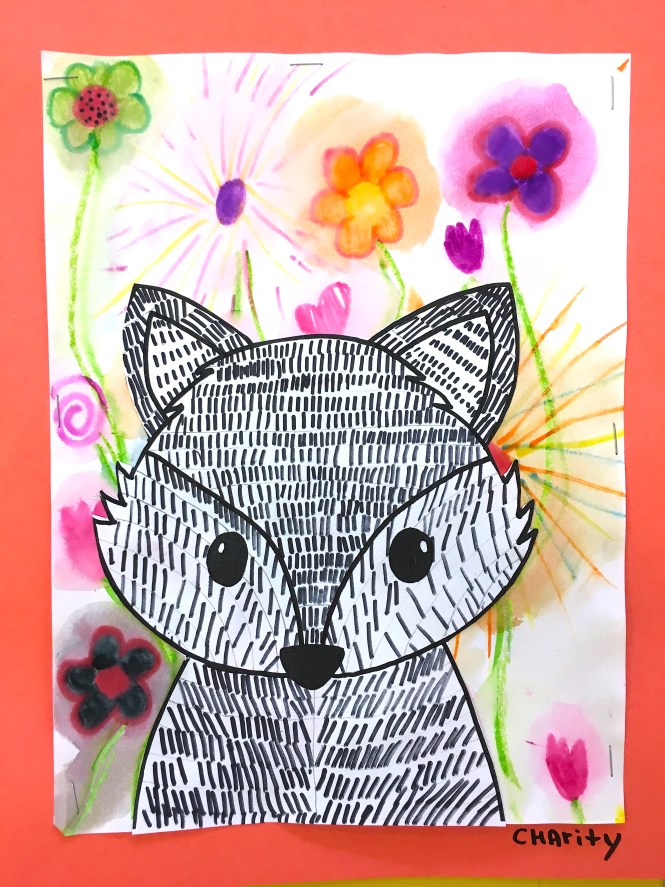
SPRINGTIME BUNNY, BEAR OR FOX! 2nd Grade

How adorable are these?!?

This lesson took (2) art classes to finish (and I had JUST enough time to squeeze in one more lesson before the end of the year)! It’s a simple one —but packs in a bunch! It incorporates the Elements of Art- Line, Shape, Color, Value and Texture! We also used overlapping, contrast and pattern in our work!  Students could choose between creating a bunny, bear cub or fox.

Read below the photos of student’s artwork to see how they were created and how to get FREE bunny and bear templates!

The fox template was clearly the most adored by my 2nd graders!

DAY 1 – Creating the field of flowers background!

Students drew flowers all over their 9×12″ 80# drawing paper using markers and crayons. They were encouraged to draw the flower heads LARGE and draw LOTS!! Especially along the top and sides, since later on the animal would be placed over their painting in the center.

I demonstrated a bunch of different ways to create the flowers first, but students could draw them any way they wanted! I also encouraged them to use bright colors.

Once their paper was filled, they drew green stems from each flower head going all the way to the bottom, using a green crayon as well as a green marker for each one. 

Once all the flowers and stems were drawn, using just water on a paintbrush, they went over each flower with water. This turns the marker into almost a watercolor consistency. I showed them how to just do one flower at a time then rinse their brush before moving onto the next so the colors wouldn’t get muddy.

Then students went over all their stems with water. The crayon part of the stems would remain a solid line since crayons resist water. We talked about the Element of Art “Value” and how the colors of the flowers would get softer and lighter in value once water was applied.

DAY 2 – Adding the animal!

Students chose a bunny, bear OR fox template to start drawing lines with sharpie to add TEXTURE!

I downloaded and photocopied the free bunny template from a website called Teachstarter found HERE . I created the bear one myself and made copies for kids, which you can get for free on my Teachers Pay Teachers page HERE. The fox template was created by an art teacher (Mrs. Bohn from McLeansville Elementary Art, via Instagram) who shared her fox drawing template with me!

I demonstrated how to draw straight and diagonal lines close together in between each section using sharpie. Students could leave the eye area as it was, or go over the bunny lashes and create longer lines. We discussed how the lines created fur- like TEXTURE. We also discussed how the black & white vs. the colorful flower background would create CONTRAST.

Once all the lines were drawn, students carefully cut out their animals and glued onto their flower background with a glue stick!

I just LOVE how simple yet beautiful this lesson is! Plus, kids continue to understand how they are applying the elements of art while creating!

Thank you for stopping by! To view other grade level artwork, click on the drop down menu on the main page, and select a grade to view more student art!

I will be posting again next week on 5th Grade “Grid Drawings” inspired by artist Chuck Close, and 4th Grade “Enlarged Flower drawings” inspired by artist Georgia O’Keeffe!

Be sure to check back soon!

Continue Reading

Matisse inspired ORGANIC SHAPES COLLAGE – 3rd Grade

I think this is a great end of the year art lesson because it only takes 3 classes (maybe even 2 if your art classes are longer than 40 minutes) and it’s fun!  But more importantly, it’s a nice way to review and assess students understanding on the basic elements of art; LINE (curving, wavy), SHAPE (organic vs. geometric), COLOR (primary, secondary, warm and cool as well as color mixing), as well as a review on overlapping, abstract art and composition.

Students in 3rd grade learned about the life and artwork of French artist Henri Matisse.

I showed them a Powerpoint slideshow of his artwork throughout the years, from his paintings to his collage work.

We talked about how Henri Matisse used a lot of bright, bold colors, simplified shapes, and was one of a few painters in his day who started a new style of painting called “fauvism” -(stemming from the word fauve, which means “wild beast”) and how later in his career, he would paint his own personal painted papers with many different colors that were then used for his cut paper collages.

They also learned how Matisse would cut right into the painted papers without drawing first, and called this technique “painting with scissors”.

We also reviewed the word collage and students noticed how many of his cut paper shapes in his collages, resembled leaves and plant life, and learned how they were organic shapes.  We talked about how organic shapes have curving, free flowing lines and can be found in nature, like in clouds, puddles, leaves, and flowers.  As opposed to geometric shapes (shapes that have straight lines and are usually symmetrical).

DAY 1 – Creating the painted papers

For this Matisse inspired lesson, students created their own painted papers first, just like Matisse did!

They began by folding a 12×18″ piece of paper 3 times, in order to create (8) rectangles, folding and pressing firmly each time to make sure they have visible creases to separate the 8 sections within their papers.

After unfolding the paper, students painted each rectangular section using liquid watercolors. Students were instructed to paint the top row with specific colors (Left to Right) using only primary colors, using only secondary colors, using only warm colors, and using only cool colors. In the top row, students could use those specific colors, painting any way they wanted –BUT– without mixing colors on their papers. The bottom row students could paint each section with any colors they wanted and could mix colors. I kept this up on the board for students as they painted (see pic below).

Some students were having a hard time recalling what those specific sets of colors were, so I gave them clues to jog their memory a little. For instance, for primary colors, I said – they consist of 3 colors, and when mixed they make the secondary colors. I also said, “If you start with the first color in the rainbow, red- (that’s your 1st primary color) then skip the next color, then you’ve got what? (Yellow- that’s the 2nd primary color) then skip the next color to ? blue (that’s your 3rd primary color). With warm colors, I asked them to think about what the first 3 colors in the rainbow were, plus pink, and with cool colors I suggested think about the last 3 colors of the rainbow.

Students tested colors out on a paper towel before applying paint to their paper. Sometimes the colors of liquid watercolors can be hard to see, since they are so saturated and appear very similar to one another in color within the ice cube trays.

DAY 2 – Cutting organic shapes

On day 2, we reviewed organic shapes. Students first cut out each painted rectangle from their painted paper. Then they cut out various free-flowing, organic shapes from each section, -1 large shape per section- cutting straight into their papers, without drawing first, just like Matisse did!  

In addition, students chose 5-6 pieces of colored construction paper to cut organic shapes from as well, to add to their collection of cut shapes for their collage. So all in all, students had up to 13-14 shapes total.

These shapes were then all paper clipped together and students wrote their name on the back of the last one and were saved in their class folder for the next class.

DAY 3 – Creating the collage

We reviewed abstract art (artwork that focuses on mainly lines, shapes and colors) and what composition meant in artwork.  Students learned that composition in art, means where things (or images) are laid out on the paper.

 Students arranged at least 8 of their cut organic shapes on a sheet of 12×18″ white 80# paper, moving them around on the paper, considering the composition first before gluing, and overlapping at least 5 shapes, before gluing into place.

I really love teaching this lesson. Not only is Matisse one of my favorite artists, but the vivid colors and arrangements of shapes turn out so beautifully and each collage ends up looking so unique!

Thanks for stopping by! Be sure to check back soon for my next posts on 1st Grade “Watermelon Weavings” , 2nd Grade “Springtime Bunny, Bear, or Fox!”, 4th Grade “Enlarged Flower Drawings” and 5th Grade “Grid Drawings”!

Continue Reading

Mixed-Media Flowers! Special Education

How adorable are these!! I love lessons that incorporate mixed-media and 3D elements!

This fun mixed-media lesson took 2- (40 min.) art classes to complete.

DAY 1

On a sheet of 9×12″ tagboard, with a pre-drawn horizontal line drawn near the middle of the paper, students colored each section using the side of an oil pastel. We used 2 different colors, one for the top section and one for the bottom section.

Then students painted over each section with liquid tempera paint.

Then we used a texture comb created from a recycled plastic gift card to scrape the paint while wet, to create various lines and texture!

We set them aside to dry, then began creating the model magic flowers.

Students started off with a small piece that they rolled into a ball, then pressed slightly to flatten it a bit. We used scissors to cut small triangular sections out all around, then pinched the ends to create the flowers petals.

The left over model magic that was cut out, was rolled into very small balls and flattened to make the flowers centers.

A green pipe cleaner was inserted into the flowers for the stems, and they were set aside to dry completely, until the following week!

DAY 2

Students painted their flowers with liquid tempera.

Then they painted a paper towel tube that had been pre- cut into smaller pieces.

The flowers and tubes were set aside to dry. Once dry, I hot glued the paper towel tubes to their painted papers, as well as their flowers and voila! A lovely project for springtime, with tons of color and texture!

Lesson inspiration from Cassie Stephens – Thanks Cassie!

UP NEXT!! I’LL BE POSTING THE FOLLOWING VERY SOON! …..

3RD GRADE – Matisse inspired Organic Shapes Collage

2ND GRADE – Springtime Bunny, Bear or Fox!

1ST GRADE – Watermelon Weaving!

Thanks for visiting my blog!

Continue Reading

1st Grade “Dream Houses”

This fun 3 day art lesson—- (3) 40 minute art classes—-is inspired by the book “The Big Orange Splot” by Daniel Pinkwater.

I absolutely LOVE this book!

It’s about a man, Mr. Plumbean, who lives on a street with his neighbors who all have the same exact house on “a neat street” as they say in the story.

Then one day, a big splot of bright orange paint falls on his roof. The neighbors all get annoyed by the random splot and ask him to get rid of it so they all “have a neat street” again.

Instead of getting rid of it, he adds to the splot, and paints his home with a ton of bright, vivid colors, and pictures of fun, random things ALL over.  His neighbors get really upset at him and ask him why he won’t change it back to the way it was before. He declares to all his angry neighbors “my house is me, and I am it…..my house looks like all my dreams” and doesn’t change a thing.

Soon after…. one by one… the neighbors try to have a talk with him to change it back. BUT…. after talking to Mr. Plumbean, each neighbor gets INSPIRED! and ends up changing all THEIR houses to look like their own dreams!

After reading the story, we talked about how it’s important to be yourself and to not be afraid to stand out, and talked about how boring it would be if everything looked the same. Then I showed students examples of previous 1st graders artwork, as well as a few of my own, then kids got started!

I had no rules for this art lesson except to add a pattern somewhere within their work! I wanted to let them be as creative as possible with very little instruction. Kids could draw whatever kind of house they wanted! It didn’t have to be rectangular or square like most houses—it could be any shape! It could be a diamond shaped house, a slice of cake, a puppy, a cookie, a robot, a spaceship, a boat, a unicorn, slides coming from the roof to a pool in the yard….you get the idea!

Check them out below- They came out fantastic!

(Photos of students creating them below their artwork too!)

Students drew on 12×18″ drawing paper with pencil, then outlined all lines with a black sharpie, then colored in their houses with crayons. The final step was painting the background with blue (for sky or underwater scene) or black (for space or nighttime scene) using liquid watercolors.

NEXT UP FOR FIRST GRADERS……….. “WATERMELON WEAVINGS”! STAY TUNED FOR THAT POST SOON 🙂

Thanks for stopping by! I will be posting 3rd grade self-portrait artwork inspired by artist Frida Kahlo NEXT, and 2nd grade “3D Water Lilies” inspired by Claude Monet VERY VERY SOON!

Continue Reading

RADIAL SYMMETRY PRINTMAKING – 4TH GRADE

Read below to find out how we created these, see step-by-step pics and watch my YouTube tutorial on this lesson!

Printmaking is one of my favorite things to teach in art. I love it because it always has an element of surprise with the results each time. Getting all the “Ooooh’s” and “Ahhh’s” after printing is so fun and magical and is always fun to see!

4th Graders used their previous knowledge on printmaking from when they were in 3rd grade when creating their “Complementary Creature Prints”. 3rd grade students used markers to print… and this time, as 4th graders… used black tempera paint to print. We used liquid watercolors to create the background before printing a symmetrical radial design on top using black tempera paint.

I love how colorful they are and loved showing students a variation in printmaking. They did a fantastic job!

This lesson took 4 to 5 (40 minute) art classes to complete.

DAY 1 – PAINTING THE RADIAL RAINBOW DESIGN

On the first day of the lesson, we reviewed symmetry (images that are the same on both sides) and students were introduced to radial design (a design that can include any lines, shapes or colors that starts in the center, and radiates outwards in a circular way). I explained we’d be making a symmetrical radial rainbow painting.

After demonstrating, and reviewing the order of the rainbow, students then measured to locate the center of their paper, using a ruler and marked the 6″ spot with pencil. From the center out, they then painted a radial rainbow design on their 12×12″ tagboard with liquid watercolors.

DAY 2 – DRAWING THE RADIAL DESIGN

Students drew curving lines (with some space between each line) on a 6″ square piece of copy paper that had been folded into a triangle, in pencil.

Then drew different lines and/or shapes between each curving line. Making sure not to draw too small or too detailed. Simple is best. They could be a pattern of lines and shapes, but didn’t have to be.

Then students opened the paper up, and traced over their pencil lines with a black sharpie.

Then students flipped up the blank bottom half over the top half that had been traced in sharpie like below.

The drawing can be seen through the paper (as shown on the picture to the right above). Then students traced over their lines with a pencil like below.

TIP: Place a sheet of white paper underneath your work while tracing so the lines can be seen more clearly. OR place the paper on a window to allow light to shine through the backside to see more clearly as you trace. OR- rather than using copy paper folded into a triangle, use tracing paper.

Once ALL the lines have been traced, THEN unfold, by taking the bottom half out like below. You should be able to see the pencil part on top, and the backside of the sharpie part below. Here you can now see the entire design is continuous on both halves of the paper.

From here, take the paper and tape it to a 6″ square cut piece of styrofoam (the printing plate). Use clear tape and only tape it to the top in 2 areas so the paper can open and close like below. Don’t worry about the tape covering your drawing a bit.

Once the drawing is taped onto the printing plate, students started tracing over ALL the lines with a dull colored pencil. (The colored pencil lets you know where you have traced since it leaves a colored line). Press firmly as you trace. This step transfers your drawing onto the printing plate.

It’s a good idea to check to see if its transferring well enough, so flip up the taped down drawing to check how it’s coming along. As long as you can see the lines indentations on your printing plate well enough, you’re good!

Continue tracing with a dull colored pencil until the entire design is traced.

Once that’s done, students flipped over the paper they were tracing. Here you should be able to see the drawing completely transferred onto the printing plate like below.

Next, students traced over their indentations of their design on the styrofoam printing plate with a dull colored pencil. (Tracing again pressing firmly). This step is crucial and creates a nice deep indentation which creates a clear print later on. If it’s not pressed in twice (once with paper over the styrofoam, and again a second time on just the styrofoam the overall print wouldn’t be as clear when time to print.)

From here, students then colored in *some* of their shapes they created within their design with colored pencil. Again pressing firmly! Areas where it is colored in, will reveal more rainbow from the painting created. Students could fill in as much as they wanted or as little as they wanted. This step was the final step before printing, so kids were very anxious to get printing! Teacher example on left, student example on right.

Once shapes were filled in, students flipped over the styrofoam printing plate, and drew an arrow with sharpie pointing to the corner where they started their drawing.

*Technically, to print a symmetrical radial design, the arrow could be drawn pointing in ANY one chosen corner, as long as it’s in just one corner. For a complete circle design like we created, we drew the arrow in the corner where we originally started the curving lines.

HOWEVER, no matter where you place the arrow, this arrow is necessary to know where to position the printing plate on the paper each time you print. The arrow should always point to the center of the paper each time it’s printed. Doing this creates the symmetrical radial design. (More on this below). They also wrote their name and class in sharpie on the back somewhere as well.

Then the paper that was taped on gets taken off and thrown away and students were ready to print!

DAY 3 – PRACTICE PRINTING ON 12X12″ WHITE PAPER FIRST

After a printing demonstration, students created a practice print on white paper before moving onto their final copy (on their rainbow painting).

Students shared plates of black tempera paint and brayers and rolled out their brayer onto the plate of black paint a couple times. Since the paint has a slippery texture, it’s important to THEN roll the brayer onto a sheet of scrap paper to get the paint evenly distributed onto the brayer. This also gets rid of any excess paint before rolling onto the printing plate.

Then the brayer gets rolled onto the printing plate.

Once students evenly coated their printing plate with black tempera paint, they carefully lifted it up and printed onto 12×12″ white 80# paper. It’s important to have the printing plates edges lined up with the papers edges and have the arrow pointing to the center of the paper.

Then students pressed down with the flat of their hands and then used a CLEAN brayer, and rolled over the backside of their printing plate all over to transfer the design to create the first print like below.

Then, lifted it off to repeat those steps 3 more times, rotating the printing plate so the arrow pointed towards the center of their paper each time they printed.

DAY 4 – 5 FINAL STEP! PRINTING ON THE RAINBOW PAINTING!

Students reviewed the printing process and continued to print their design onto their rainbow painting that they painted on day 1!

It was fun… but very messy!!!

This is why we drew a BIG arrow! So you can see it!

If you haven’t see it yet, Here’s my YouTube video tutorial below. I hope you like it!

Continue Reading

OP ART BY 5TH GRADE!


5th Graders did such a fantastic job creating these op art paper cone drawings!!! I’m super proud of their hard work!!!

Students LOVED it too and couldn’t believe it could be created using just sharpies, and colored pencils!

This lesson took about 5 (40 minute) art classes to complete. 


ON DAYS  1 and 2: Students were introduced to various OP Art by artists Victor Vasarely and Bridget Riley, and learned what Op art was (Optical Illusion Art) with a quick slideshow of work.  

Six straight lines that intersect at the same spot, were drawn ahead of time on 80# 10×10″ paper for each student with a ruler; Creating 12 “slices” in total. 

Students followed along with me while I demonstrated under the document camera how to draw alternating curving lines within each pie slice, starting in the center.

Then they labeled every other slice with a “B” lightly in pencil, to mark that space as black.

Students then started tracing over the smallest slices labeled “B” in the center, using an extra fine point Sharpie, then filled in. 

As areas got larger, kids switched to a Fine Point Sharpie, (since it has a thicker tip), and filled in the rest.  

ON DAY 3, I reviewed the element of art VALUE with students and showed them how to create subtle value changes within each pie slice with colored pencils.

Students used a white colored pencil in the black areas first to create highlights, pressing hard with the white colored pencil down the middle, creating a bright white strip. Then as they drew from the middle outward, to each side, they pressed lighter and lighter, leaving the sides black.

Then, using a black colored pencil in just the white areas, they drew darkest along the sides and gradually pressed lighter and lighter towards the center—leaving the center strip white.

This lesson ties in nicely (and is a great precursor) to the grid drawing lesson that occurs later on in the year!

Thanks for stopping by! Be sure to check out the page “STUDENTS CREATING ART” —NEW PICS HAVE BEEN ADDED : )

AND BE SURE TO CHECK BACK THIS WEEKEND FOR 4TH GRADERS VICTORIAN HOUSES!!!

Continue Reading

MIXED MEDIA BIRD NESTS- 5TH GRADE!

LOVE, LOVE LOVE THESE!! This is a new lesson I introduced this year for 5th grade and it’s definitely a keeper!! Thank you Painted Paper Art for this wonderful lesson idea!

These are created by 5Y, 1 (of my 5)  5th grade classes! (Other classes are going on day 2 of the lesson later on in the week). It’s a 3 day art lesson (40 minutes each) and incorporates ALL the Elements of Art (value, shape, line, color, form, space, and texture!)

HERE ARE A FEW CLOSE-UPS OF INDIVIDUAL NESTS!


DAY 1: 

Students created the nest using oil pastels on a 6×6″ sheet of manila tagboard. They drew a large circle with pencil, then chose whatever color blue they wanted, to fill in the background.

They then drew a small black circle in the center, a loop of dark brown around the black circle, then looped various shades of brown oil pastel within the remaining part of the nest, layering as they went around. After that they drew short, curved lines extending outside the nest with brown, to create little pieces of hay or sticks sticking out from the nest.

Students then used various shades of yellow and golds to overlap the brown, until the manila paper was completely covered with oil pastels. As a final step with oil pastels, students used black to lightly draw circles close together extending outward from the center, to create the illusion of space and the nest going inward in the center.


For the last step on day 1, students glued on strips of pre-cut, painted papers all around the nest, to add texture!


DAY 2: 

On the second day of the lesson, students shaped and created 3 eggs out of model magic air dry clay and glued them on in the center of their nests with tacky glue. Then they glued down 8-10 small twigs using tacky glue to add even more texture to their nests! (BTW- Twigs were collected while walking my dog in the park on a previous day. With only 7 more art classes remaining before summer break, (although it might have been fun), I didn’t want students to spend an art class searching around the school for them!!)

I love the various shades of blue in this one!

I have to say, I REALLY LOVE tacky glue!! I’ve used it for so many art lessons recently and it’s WAAAAAY better than regular old white school glue! It adheres quickly (which is super important for this lesson) and best of all—dries clear!

These were all set aside to completely dry in Mason paper box tops until the following week!


DAY 3: 

Students painted their eggs using liquid tempera (students could choose from a variety of blue/ blue-green paints).

They had the option to then add spots of white and brown speckles using the end of a paintbrush handle.


Students did a wonderful job creating their beautiful bird nests and eggs, I couldn’t WAIT to hang them all up!!!!

I hot glued twigs to create their sign and added some colorful cupcake liners for flowers! More nests to come SOON  to fill in the empty spaces on this bulletin board!!! 


Thanks for checking out my blog!! Be sure to check back tomorrow (Tuesday) night for another new post on some NEW artwork!!! To view other 5th grade artwork -click on 5th Grade Art Lessons under the drop down menu! 


Continue Reading