SPRINGTIME BUNNY, BEAR OR FOX! 2nd Grade

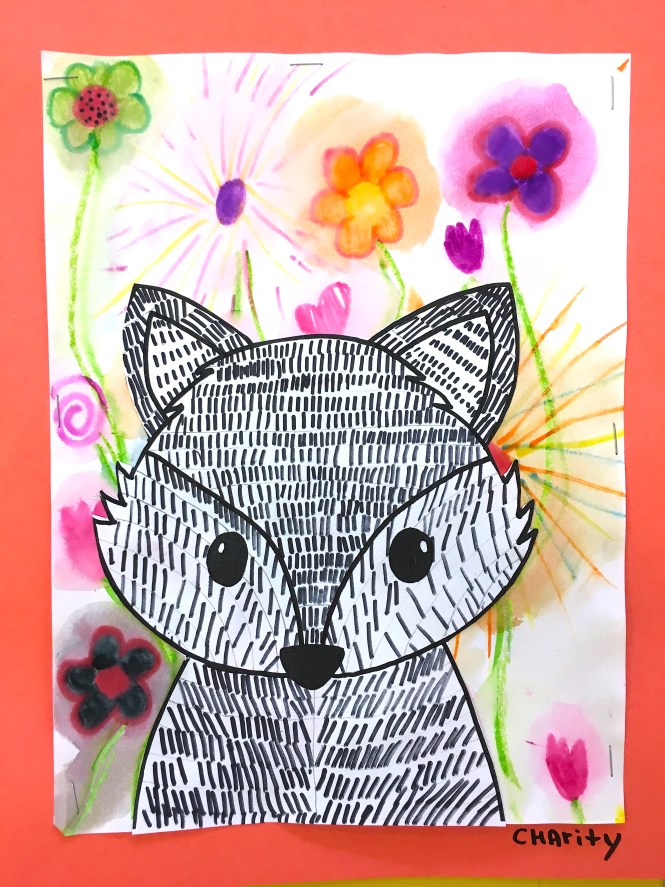
How adorable are these?!?

This lesson took (2) art classes to finish (and I had JUST enough time to squeeze in one more lesson before the end of the year)! It’s a simple one —but packs in a bunch! It incorporates the Elements of Art- Line, Shape, Color, Value and Texture! We also used overlapping, contrast and pattern in our work!  Students could choose between creating a bunny, bear cub or fox.

Read below the photos of student’s artwork to see how they were created and how to get FREE bunny and bear templates!

The fox template was clearly the most adored by my 2nd graders!

DAY 1 – Creating the field of flowers background!

Students drew flowers all over their 9×12″ 80# drawing paper using markers and crayons. They were encouraged to draw the flower heads LARGE and draw LOTS!! Especially along the top and sides, since later on the animal would be placed over their painting in the center.

I demonstrated a bunch of different ways to create the flowers first, but students could draw them any way they wanted! I also encouraged them to use bright colors.

Once their paper was filled, they drew green stems from each flower head going all the way to the bottom, using a green crayon as well as a green marker for each one. 
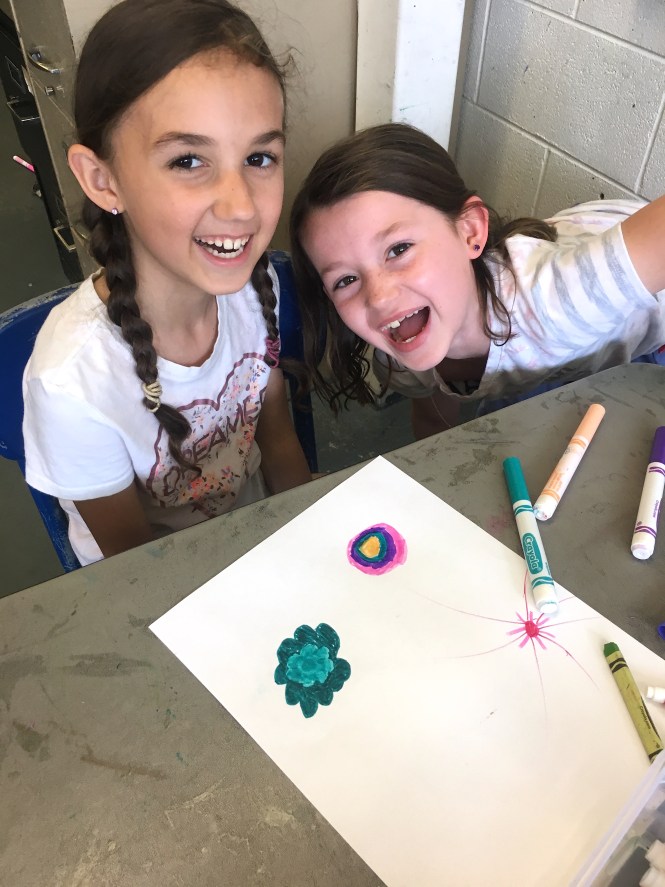
Once all the flowers and stems were drawn, using just water on a paintbrush, they went over each flower with water. This turns the marker into almost a watercolor consistency. I showed them how to just do one flower at a time then rinse their brush before moving onto the next so the colors wouldn’t get muddy.

Then students went over all their stems with water. The crayon part of the stems would remain a solid line since crayons resist water. We talked about the Element of Art “Value” and how the colors of the flowers would get softer and lighter in value once water was applied.

DAY 2 – Adding the animal!

Students chose a bunny, bear OR fox template to start drawing lines with sharpie to add TEXTURE!

I downloaded and photocopied the free bunny template from a website called Teachstarter found HERE . I created the bear one myself and made copies for kids, which you can get for free on my Teachers Pay Teachers page HERE. The fox template was created by an art teacher (Mrs. Bohn from McLeansville Elementary Art, via Instagram) who shared her fox drawing template with me!

I demonstrated how to draw straight and diagonal lines close together in between each section using sharpie. Students could leave the eye area as it was, or go over the bunny lashes and create longer lines. We discussed how the lines created fur- like TEXTURE. We also discussed how the black & white vs. the colorful flower background would create CONTRAST.

Once all the lines were drawn, students carefully cut out their animals and glued onto their flower background with a glue stick!

I just LOVE how simple yet beautiful this lesson is! Plus, kids continue to understand how they are applying the elements of art while creating!

Thank you for stopping by! To view other grade level artwork, click on the drop down menu on the main page, and select a grade to view more student art!

I will be posting again next week on 5th Grade “Grid Drawings” inspired by artist Chuck Close, and 4th Grade “Enlarged Flower drawings” inspired by artist Georgia O’Keeffe!

Be sure to check back soon!

Continue Reading

Dandelion Puffs – 4th Grade

Additional artwork below!!

This easy and fun 2 day art lesson focused on the elements of art; Line, Shape, Color and Value. Students also learned about a new watercolor resist technique using rubber cement before painting!

Special shout out to artroombritt.blogspot.com for this lesson idea!

DAY 1

Students observed various drawings of dandelions and reviewed the meaning of composition in artwork, (composition= the way things are laid out or where things are drawn/placed on paper).

Students drew three stems spaced apart a bit coming from one side of a sheet of 9×12″ tagboard with pencil. They could be drawn coming from either side of the paper going towards the middle.

They drew a small circle at the tip of each stem for the dandelions center and then lightly drew a large circle around it to act as a guideline to where their dandelion seed heads would be drawn to, to create a full, fluffy dandelion puff.

Students drew 1 large dandelion and 2 smaller ones on either side of the large one. Then drew a variety of seed heads stemming out from the center of each dandelion. I demonstrated various seed head tips for drawing before students drew on their own papers. I also offered a handout to refer to and observe, if they wanted while drawing.

Then once all three were drawn, they added drifting seed heads blowing away from the dandelion puffs in the wind. These drifting seed heads were drawn traveling in different directions (just like in real life) and not only adds interest, but creates a nice composition with the three dandelions along the opposite side.

Then students went over their stems lines and dandelion puffs lines and drifting seed heads with a black sharpie. After using sharpie they erased any pencil lines that remained.

Once that was done, after class, (when students were no longer in my art room), I brushed on a thick layer of rubber cement where each circular dandelion puff would be, as well as on the drifting seed heads. The rubber cement was a bit stinky and isn’t healthy to breathe in, so I worked next to an open window. This is why I applied the rubber cement and not the students.

The rubber cement was left to dry until the next class. (BTW- This doesn’t take up much rubber cement at all- I used about 3 small jars for 4 classes (roughly 24 students per class).

I used an old tempera brush rather than the rubber cements brush that it comes with. I found it was much easier to spread that way.

DAY 2

Before applying paint to our drawings, we reviewed warm and cool colors.

I had ice cube trays filled with liquid watercolors (one end with warm colors (warm colors=reds, pinks, oranges and yellows) and the other end with cool colors (cool colors= blues, greens and purples).

We also reviewed the wet-on-wet watercolor technique before painting. After demonstrating, students applied water only to 1/2 their paper quickly with a watercolor brush. THEN applied dabs of either just warm colored paint OR just cool colored paint onto the wet areas using one color at a time.

Students noticed how the paint spread outward from where they dabbed little bits of paint over the watered down paper. The water helps spread the paint and it also changes the value of the color making the color lighter and less vibrant (value= the lightness or darkness of a color).

Then once one 1/2 of their paper was painted, they dabbed the painted section with a paper towel while still wet, to help soften the color and spread the paint even more.

Then painted the other 1/2 of their paper with water only and applied paint to that wet area then dabbed off with a paper towel.

Once paintings were dry, the rubber cement was rubbed off, revealing the white dandelion puffs!

Thanks for visiting my blog!! Check back soon for new 1st grade artwork! Next week!


Continue Reading

Birch Tree Landscapes- 2nd Grade

This art lesson took about ( 3) 40 minute art classes to complete. Students learned about foreground, middle ground and background and how it creates a sense of space in artwork.

Read more below students artwork to find out how they were created!

DAY 1 – Creating the birch trees

After introducing foreground, middle ground and background to students, showing them multiple student artwork examples from previous years, and demonstrating the steps for day 1 of the lesson, students got to work creating their birch trees. We used 12 x 18″ medium weight tagboard for the paper.

Students drew 1 large tree in the foreground (area closest to the viewer- with objects drawn LARGEST along the bottom of the paper to show this) going all the way to the top of their paper.

Then drew a land line in the middle ground(area in artwork that is placed in the middle of the paper or canvas, with objects drawn a bit smaller in this area, to show it is a bit further away from the viewer.) I demonstrated to make sure that they jumped over the tree as they drew the middle ground! Then proceeded to draw 2 slightly thinner trees from the middle ground up to the top of their paper.

Then they drew another hill / land line to show grass and trees growing in the background. This line was drawn near the top of the paper to show objects that are the furthest away from the viewer. Objects along this area are drawn the smallest to show they are the furthest things away in the artwork.

Once these areas were drawn with largest to smallest birch trees, going from the bottom of their paper to the top, students used a small piece of recycled currugated cardboard dipped into black paint to create the birch tree bark.

Dipping the currugated side of the cardboard into a small amount of black tempera paint, then scraping from one edge of the tree to the other, students created the black lines within their birch trees. ***It’s important to tap off extra black paint on the paper plate, before scraping, otherwise sometimes too much black paint can create larger black blocks of sections as opposed to black “lines”.

After creating the black lines for the birch bark in each tree, we created 1-2 branches for each tree by tilting the cardboard diagonally along the edges of our trees, and dragged the cardboard downward.

DAY 2 – Creating grass, flowers and painting the landscape

Students drew grass blades within their landscape using 2 different shades of green crayons and yellow. They pressed HARD as they drew the lines– It’s important to press hard not lightly here because the crayon bits would be painted over in the next step (creating a “crayon wax resist” technique with watercolors).

I showed kids how to hold all 3 crayons in one hand, drawing vertical and diagonal lines for the grass. (Doing this makes it easier and faster!) Some students held all 3 ok, and some preferred holding 2 then drawing the rest with the 3rd crayon after.

Then they drew a variety of flowers using crayons within each grassy section.

I love the triangular shaped crayons Crayola makes! They don’t roll off the tables!

Once complete with grass and flowers, students painted the grass and sky with slightly watered down liquid watercolors! Creating a crayon wax resist.


DAY 3- ADDING THE WOODLAND ANIMALS TO THE LANDSCAPE!

Students referred to a variety of “step-by-step” how to draw animals that I had created and stapled together into packets to draw at least 1 animal to add to their landscapes.

Foxes, squirrels, owls, skunks, bunny’s, racoons, deer, and wild horses (which could OF COURSE be made into unicorns!) were in the packet.

Students chose 1-2 animals to draw, and used their observational drawing skills to draw them, color in with colored pencils, cut them out and glue onto their beautiful landscapes!

LOVE her Amelia Earhart outfit! Some 2nd graders were doing book report presentations on this day in their classrooms!

And there you have it!! Beautiful work everybody!!

Continue Reading

3rd Grade- Complementary Creature Prints!

3rd graders did such a fantastic job printmaking!! Take a look below!

(Read more below the pics to find out how they were created, and to view my YouTube tutorial on this lesson!)

This lesson took about 5 (40 min.) art classes to finish, and create three prints of one drawing. We used markers and styrofoam printing plates to create our prints.

DAYS 1-2 

On the first day of the lesson, I showed students prints students created from previous years as well as my own examples. Then I showed them the first portion of my video tutorial and discussed what printmaking was. The book Where the Wild Things Are by Maurice Sendak was inspiration for this lesson.

Kids then got to work drawing their own made up creature on 8.5″ x 11″ regular printer/copy paper with pencil. The goal was to create a unique creature, large on the paper, with simple lines and details. I explained their creature could consist of a combination of animals, aliens, monsters, inanimate objects, people, sea creatures, food, fantastical creatures….whatever they wanted!  Something that was from their own imagination.

(I didn’t get a chance to take photos of kids drawing so this pic and the next few with the pink background are ones I created for my video tutorial)

My example drawing

Once drawn, students then taped their drawing onto a sheet of styrofoam (the printing plate) to trace. Being sure to tape it to the top in two areas where there wasn’t any image, so the paper wouldn’t move on them while tracing.

Then using a dull colored pencil; not too sharp (if its too sharp, it could tear or puncture the styrofoam) they traced over all their lines pressing firmly but not super hard, to transfer their image to the printing plate underneath. I have them use a colored pencil so they can see where they’ve already traced over their pencil lines.

Below you can see the image has transferred to the styrofoam plate.

Once that’s done, students trace over all their lines indented in the styrofoam plate. They used a colored pencil for this step as well. The reason they trace twice (once with their drawing over the styrofoam and once on the styrofoam only) is so the indentations are deep enough for printing a crisp, clear image of their drawing.

Styrofoam plate all ready for coloring in with markers!

DAYS 3-5 

Students learn what complementary colors are, (colors opposite one another on the color wheel and consist of one primary color and one secondary color. (red + green, blue + orange, and yellow + purple).


Students learned that when complementary colors are used next to one another in artwork, it makes an image pop and helps make the artwork stand out.

On the styrofoam using regular washable Crayola markers, they colored their creature with one set of complementary colors, and then their background with a different set.  It’s important that the markers are juicy (aren’t dried out) for this. (I saved and set aside a large box of markers for just this lesson, to ensure students would have juicy markers!)

After the styrofoam is completely colored, they take off their taped on drawing and sprayed a sheet of 9×12″ 80# drawing paper using water from a spray bottle. (For the spray bottles, I just use recycled empty spray cleaner bottles after thoroughly rinsing out).

They sprayed the paper 6 times- two on top on either side, two in the middle on either side and two along the bottom on either side of the paper.

Then using a damp sponge, they hold down the paper along the bottom, and gently wipe going away from their fingers in one direction to help spread the water evenly all over the paper.

They then lay their colored styrofoam, color side down, onto the wet paper. They press all over the back of their printing plate using the flat of their hands to help transfer their image to the dampened paper. After pressing all over for about 10 seconds, they used a brayer (which is like a mini paint roller except it has a rubber roller) to roll over the back of their printing plate to help further push and transfer the marker to the damp paper to create their print.

(I explain to students it’s VERY important to always have one hand holding down the styrofoam plate, while pressing with their other hand or using the brayer, so they don’t move their styrofoam which would smudge their print, thus creating a blurry one).

Students roll the brayer over the entire backside of their plate for at least 15 seconds. Then while holding down a corner with one hand, they lift the opposite corner with the other hand to check if there are any bald spots. If there are any bald spots (where their isn’t any color), they roll over that area again and/or use their fingers to press into any smaller detailed areas where needed. 

Once they check all areas, they lift off the styrofoam plate to reveal their print!

There are a lot of steps involved in creating these prints, which can be tricky to remember!  So I have students watch the printmaking steps of my video tutorial in the beginning of the first couple of art classes when they have begun printing, to review and help them remember!

I’m so glad I decided to make that video for this lesson! Students find it helpful to watch and such a time saver from constantly having to set up and waste paper and marker ink each time as I would while demonstrating…. and since it’s recorded- I don’t ever have to worry about forgetting to tell them something!

Once they print their first print, they repeat the process of coloring their printing plates and wetting their papers to print, and pressing to create 3 prints of the same image total. This way, students have some practice with printing and have the opportunity to create a good, clear, colorful print!

Here is my video tutorial on this lesson!

https://youtu.be/njw-xLPtq_k

Thanks so much for stopping by! To view other art tutorial videos I’ve made click on “Art Instruction Videos” under the drop down menu or visit my YouTube channel!

Continue Reading

OP ART BY 5TH GRADE!


5th Graders did such a fantastic job creating these op art paper cone drawings!!! I’m super proud of their hard work!!!

Students LOVED it too and couldn’t believe it could be created using just sharpies, and colored pencils!

This lesson took about 5 (40 minute) art classes to complete. 


ON DAYS  1 and 2: Students were introduced to various OP Art by artists Victor Vasarely and Bridget Riley, and learned what Op art was (Optical Illusion Art) with a quick slideshow of work.  

Six straight lines that intersect at the same spot, were drawn ahead of time on 80# 10×10″ paper for each student with a ruler; Creating 12 “slices” in total. 

Students followed along with me while I demonstrated under the document camera how to draw alternating curving lines within each pie slice, starting in the center.

Then they labeled every other slice with a “B” lightly in pencil, to mark that space as black.

Students then started tracing over the smallest slices labeled “B” in the center, using an extra fine point Sharpie, then filled in. 

As areas got larger, kids switched to a Fine Point Sharpie, (since it has a thicker tip), and filled in the rest.  

ON DAY 3, I reviewed the element of art VALUE with students and showed them how to create subtle value changes within each pie slice with colored pencils.

Students used a white colored pencil in the black areas first to create highlights, pressing hard with the white colored pencil down the middle, creating a bright white strip. Then as they drew from the middle outward, to each side, they pressed lighter and lighter, leaving the sides black.

Then, using a black colored pencil in just the white areas, they drew darkest along the sides and gradually pressed lighter and lighter towards the center—leaving the center strip white.

This lesson ties in nicely (and is a great precursor) to the grid drawing lesson that occurs later on in the year!

Thanks for stopping by! Be sure to check out the page “STUDENTS CREATING ART” —NEW PICS HAVE BEEN ADDED : )

AND BE SURE TO CHECK BACK THIS WEEKEND FOR 4TH GRADERS VICTORIAN HOUSES!!!

Continue Reading

2ND GRADE ABSTRACT SELF-PORTRAITS!

This fun self-portrait 3 day lesson combines art exploration in abstract art and color theory.

I’ve done this a few years now and it’s definitely one of my favorite lessons for 2nd grade!

More details on how they were created below students artwork!

Students could pose anyway they wanted for their photos— I Love the variety! Some fun and silly, some serious and contemplative, and some just happy and smiling!

DID SOMEONE SAY HEAVY ON THE PHOTOS PLEASE?!!

YOU GOT IT!

DAY 1


On the first day of the lesson, I showed students my examples, students artwork from previous years, as well as just the abstract drawings before paint was applied. I asked students what they thought abstract artwork might be while looking at all the examples. Students noticed that the drawings and paintings were basically lines and shapes! We discussed how abstract art focuses mainly on lines, shapes, and colors and didn’t show a “picture” of anything (a person, a dog, a tree etc.)

Students then looked at a fun, quick slideshow of artwork by various abstract painters (Wassily Kandinsky, Paul Klee, Joan Miro, Jackson Pollock and William de Cooning).

Students drew various lines and shapes on 12×18” tagboard in pencil, then went over all the lines with crayons being sure to press super hard (later on we would do a crayon wax-resist). They then filled out a short questionnaire with questions asking about their favorite things and questions about themselves.

DAY 2

On day 2 of the lesson, they painted their drawings with watercolors creating a crayon wax-resist.

While students worked, I took each students photo (which I later printed as a high-contrast black & white photo on printer paper).

DAY 3

In the following art class, students added additional color using NEON oil pastels by drawing shapes and lines on their dry paintings. I LOVE the addition of neon to their paintings!! Adds a nice layer of texture and so much color! This step was a new one this year, and kids and myself are happy of this new edition to the process!

LOOK AT ALL THIS FABULOUS LAYERING OF BRIGHT FUN COLOR!!


They then glued their black and white self-portrait onto their painting as well as their printed sentences that were cut into strips ahead of time.

ET VOILA!

I hope you enjoy these awesome abstract self-portraits as much as I do!! 

MORE ON THIS LESSON FROM PREVIOUS YEARS HERE!

THANKS SO MUCH FOR CHECKING OUT MY BLOG! MORE ARTWORK (ALONG WITH SOMETHING EXCITING AND NEW IN THE WORKS FOR 5TH GRADE!!) ALL COMING VERY VERY SOOOOOON!!!!!!

STAY TUUUUNED!!!! : )


Continue Reading

1st Grade “LOVE IS IN THE AIR!”

LOVE IS IN THE AIR Mixed media art lesson by 1st grade


This fun 3 day lesson incorporates the elements of art; Shape, Color, Line, Form, and Texture! We also review overlapping, and crayon wax resist painting throughout the lesson.

Kids finished them up JUST in time for Valentine’s Day!

DAY 1: CREATE WARM TISSUE BACKGROUND

Students glued pre-cut warm colored tissue paper onto a sheet of 12×18″ tagboard using watered down glue. They glued an area of the paper first, then tissue, one piece at a time, then applied another thin layer of glue on top of each piece. This ensured the tissue laid flat and stuck to the paper.

Students were encouraged to overlap as they glued pieces, and to fill up the entire paper.

Day 1- gluing tissue for the sky background — Let me tell you… creating art with tissue paper and glue are probably my LEAST favorite art materials to work with! So flippin MESSY, and seems to get EVERYWHERE!!!
BUT… in the end, I think the beautiful artwork created was well worth the mess and clean up

DAY 2 – CONTINUE GLUING TISSUE / CREATE PLANE

Students continued gluing tissue until their paper was filled in entirely. Then they each received a sheet of 8.5 x 11″ medium weight tagboard with a pre-printed outline of a plane. (I drew the plane ahead of time and photocopied them)

Students drew a variety of lines and/or shapes using crayon, pressing hard inside their plane, leaving a bit of white background showing.

Once colored to their liking, they painted over the entire plane using watercolors, creating a crayon-wax resist. Students could paint with whatever colors they wanted. Planes were set aside to dry along with their tissue backgrounds until the next class.

DAY 2: CREATING THE PLANE WITH CRAYON WAX-RESIST


DAY 3: ADD PLANE AND HEART!

Students cut out their planes, and glued using a glue stick to their tissue paper backgrounds. Then glued on the cotton batting for the planes smoke in the shape of a heart!

I demonstrated how to take SMALL chunks from the bag, and pull with their fingers creating a thinner line of “smoke” before gluing into place. This was the trickiest step! Kiddos did great!!

DAY 3: ATTACH PLANE AND COTTON BATTING FOR THE HEART! ONE OF MY FAVORITE PICS OF THE PROCESS!!!
KIDS LOOOOOVED FEELING THE TEXTURE OF THE COTTON!


BE SURE TO CHECK BACK SOON FOR 2ND GRADERS “ABSTRACT SELF-PORTRAITS” AAAAANNNNNNDDDD 5TH GRADE “OP ART

THANK YOU FOR VISITING TODAY!!!!


Continue Reading

MY NEW ART ROOM AND MUCH MUCH MORE! …

https://youtu.be/xiP_H_8B7fY

I found out late summer that I was no longer going to have to teach art off a cart, and I’d have my very own art room! Of course, as you can imagine I was thrilled with this exciting news!! I had been teaching from a cart, rolling it with art supplies for each class, down the hallways to each classroom for 4 years in the district I teach now. So since Sept. 2014!


I couldn’t wait to set up my new space and decorate all the walls! The room is awesome and has huge windows all along one wall, a sink (my other classroom at the other school I teach at doesn’t have a sink) and is pretty spacious but still cozy!

I took the video above in early December before the holidays, so that’s why you’re hearing “Christmas Time is Here” by the Vince Guaraldi Trio in the background.

I bought all my twinkly curtain lights from Amazon, which are not just up for the holidays but I am keeping them up all year round. I think it adds a nice warm, cozy, inviting (and soothing) environment.

I was so excited to show my students once I put them all up and they looved them! I had kids work with only those lights on in the room for the majority of the holiday season. With all the windows, it’s still plenty of light to be able to see while creating art!

Here are some pics of what the room looked like BEFORE below!

art room BEFORE
art room BEFORE
art room BEFORE
art room BEFORE
art room BEFORE

Here are some AFTER pics!

So here’s a re-cap snippet of SOME of the things we’ve been working on in the art room since September!

3rd-5th Monochromatic Mini Self-Portraits

Students at Amvet in 4th and 5th grade drew mini monochromatic self-portraits. Each class had their own designated color of the rainbow. At this school, I have (3) 4th grade classes and (3) 5th grade classes. At Roosevelt I had 3rd, 4th and 5th create them, since there are only 2 classes per grade level.

Students learned a variety of ways to draw different expressions and what monochromatic means. They learned how they can achieve a monochromatic look by pressing hard or light with their colored pencil to achieve various values of one color, and can create a variety of values by using various shades of a colored pencil.

Students in 1st and 2nd grade drew circles creating an abstract collaborative mural inspired by the artist Wassily Kandinsky (BELOW). They colored using a variety of colorful oil pastels, then painted around the circles filling in the remaining space of the square paper with watercolors. Once complete, I assembled them on a large sheet of black paper and hot glued into place.

1st and 2nd grade completed a Kandinsky inspired collaborative mural

Below are some art lessons we did in order by grade level so far. (These are not all of the lessons however we have finished up to this point).

1st Grade:

Hot Air Balloon Collage

This is a lesson I teach 1st grade every year, but decided to switch it up a bit, by having students draw themselves rather than glue on a photo that I take of them.

To view Hot Air Balloon Collages from previous years – click on 1st Grade Art Lessons under the main menu and scroll down! Or click HERE.

Mixed-Media Alphabet Soup

1st Grade Mixed-Media Alphabet Soup
This photo is from my hallway display from last year. Art will be hung up once the spoons and plastic letters are hot glued into place!! One of my favorite lessons for 1st grade!

Here are some cute pics of students working on their soups!

To view additional mixed-media alphabet soup art from previous years, learn how it was made and what the learning goals are for the lesson, check out the 1st grade art lessons page HERE and scroll down!

2nd Grade:

Birds Eye-View Snowman Collage

To learn more about how we created these adorable snow people and what the learning goals are for the lesson, click HERE and scroll down!

Catching Snowflakes

Click HERE and scroll down to check out previous years “Catching Snowflakes” and to learn more about this lesson!

3rd Grade:

Day of the Dead Skulls

To learn more about this lesson and see additional Dia De Los Muertos Skulls – click HERE and scroll down!

3D WINTER MUGS

To learn more about this lesson and see additional mugs (using paint rather than markers) click HERE and scroll down.

4th GRADE:

Mixed Media Donuts

To view additional mixed media donuts by 4th grade, and learn how we created them, click HERE and scroll down. To view my YouTube video tutorial click HERE and select the video!

5th Grade

Falling For Foreshortening

To view additional Falling For Foreshortening artwork by 5th grade and learn how they created them, click HERE and scroll down!

Holiday Lights

Students at Roosevelt were able to complete this lesson before the holidays but unfortunately, due to time constraints classes at Amvet didn’t have time to create these. Next year I will start this lesson earlier and try to make sure everyone in 5th has a chance to do this fun lesson for the holidays!

This wonderful lesson was inspired by the amazing art teacher artwithmrsnguyen

To view additional Holiday Lights and to learn how these were created -click HERE and scroll down to the lesson!

Here are some fun pics of students creating them! Enjoy!

Thanks so much for stopping by! I’ll be posting more artwork very VERY soon!!

I promise!!!!

Continue Reading

GRID DRAWINGS inspired by Chuck Close! -5th GRADE

Hello again everybody! Sorry for the long hiatus….. I meant to post this over a month ago when school was just out, but things have been pretty busy around here (and by busy I mean basically just totally chillin out and relaxing focusing on family, friends and my health—-but c’mon, can ya blame me?! It is summer break after all!


But back to the art lesson I’m posting about—-Grid drawings inspired by the amazing artist Chuck Close!

This was my last art lesson of the school year for 5th grade. I have taught this lesson now for 5 years (4 years at the schools I’m teaching in now, and 1 year within another district). I think it’s one of the more challenging lessons for 5th grade.

The images I print out aren’t super easy and although students have a choice on what image they want to draw, the lesson requires a lot of attention to detail and focus. Usually it takes students about 6 (sometimes even ­7 (40 minute) classes to complete.

So with that in mind, I have NO IDEA why I planned on teaching it with only about 4 art classes left in the school year…. (you’d think by now I’d of realized doing so would mean kids probably wouldn’t finish. Well… that is what happened. BUT—art isn’t always about the final product. It’s about the PROCESS. Learning about new techniques, learning about different artists, creative decision-making, discovering things about yourself, learning from mistakes and persevering through challenges.

Many students did finish, and I’d say most were probably ½ way finished. I DID however, have them draw on WAY smaller paper. In previous years kids drew on 9×12” or 8×10”, but this time round, I had them draw on 5×7” to help speed things up a bit, while still keeping the same learning goals in mind.

Students worked so hard and I’m truly impressed with their beautiful drawings! Even if unfinished.

Ok, sorry….that was a lot of text to read…  so here’s the artwork!! 🙂


Students selected one black and white photo of an animal. They could choose from about 15 different pictures.

I looked for images on Google that had a variety of value changes, were challenging enough in that they had some nice details, but tried to find ones with a simple background. Then I printed each of them as a 5×7” on 8.5” x11” printer paper.

When making a selection, I laid out each image in stacks of about 10 along a long table, then called groups of kids up (5 or 6 kids at a time) to make a choice.

Students used a 1” strip of cardboard to create their grids. I’ve had them use actual rulers before, but it proved to be too tricky getting accurate measurements and straight lines.

They drew a grid on their chosen black and white animal picture, then numbered each square, then drew the same exact grid on a piece of 5×7” drawing paper and numbered that grid as well.

Here’s some pics of students doing just that!

I explained to draw very lightly on the white drawing paper (so later on the grid lines and numbers wouldn’t show as much) but they could draw pressing much harder on their black and white animal pic in order to see the grid lines and numbers better.

To help students draw with a lighter touch, I showed them how to hold the pencil so their fingers gripped near the eraser rather than towards the pencils tip. The closer your fingers are towards the tip of the pencil, the more likely it is you will draw darker lines.

Once their grids were drawn and numbered, they drew just the contour lines of their animal, while observing just one box at a time. Like so…..


Once all the contour lines are complete, we reviewed what VALUE meant and after doing a demo under the doc camera, they started shading using various drawing pencils. I had them use just 2B, 3B, 4B and 6B.

I also had small handouts to refer to on a value scale with references on what pencil would probably work best for each value within their picture.

We also reviewed how you can change the value of the pencil marks by simply pressing harder or lighter as well.

Students also learned how to use a TORTILLION or aka a blending stump to soften/blur lines and create lighter values.

You can see the tortillion (not tortilla! Tortillion I joked with the kids) on this students picture of a giraffe.


Kids were amazed at how much detail they acheived and how accurate they could draw what they were seeing—-just by simply slowing down, and really paying attention to all the little details and nuances within each and every square!!


To view a great video and interview with Chuck Close himself– click on the video below!! 


And another if you like!….


To view additional Grid drawings by my 5th graders in the past—- go HERE and then scroll down until you see it! This is also where you can view the learning goals of my lesson.

Thanks for stopping by!! I will be posting again within the next week or so—so Stay Tuned!! 🙂 


Continue Reading

2nd Grade “Thinking of Summer Self-Portraits” and 1st Grade “Dream Houses”

2ND GRADE- “THINKING OF SUMMER” SELF-PORTRAITS!

Every year, near the end of the school year, I’ve had my students do this quick, fun lesson!

We draw just a portion of our heads large along the bottom of a 12×18″ 80# sheet of drawing paper. I demonstrate on how to draw a “rainbow line” along the bottom and then add eyes and eyebrows.

We talk about different facial expressions and how our eyebrows go up when we get excited!

We went around the room and shared a variety of ideas!  They then drew images on what things they wanted to do over summer break within a large thought bubble. They could incorporate words too, but I told them to focus more on drawing than writing.

I demonstrated on how to draw a few ideas (one being a pair of sunglasses that looked three-dimensional, which kids loved drawing and did a fantastic job!)

Once complete in pencil, they outline all lines with a black sharpie then colored and painted!

One year I had students create a cut out version of themselves. After drawing, they cut out the entire head and neck and then cut the top portion of their heads off and glued it onto separate 12×18″ paper hinged open with the thoughts/images coming out. 

AND NOW FOR SOME CUTE PICS OF KIDS CREATING THEIR ART! ….

I LOVED her t-shirt so much I had to take a pic!


1ST GRADE- “DREAM HOUSES”

On the first day of this lesson, I read the book “The Big Orange Splot” by Daniel Pinkwater.

I LOVE this book!! If you haven’t read it to your child, or students you should!

It’s about a man, Mr. Plumbean, who paints his house to “look like all his dreams”. In the beginning of the story, a big orange splot of paint falls on his house. Instead of getting rid of it, he adds to the splot, and paints his home with a ton of bright, vivid colors, and pictures of fun, random things.  His neighbors get upset at him and want all the houses to look the same. Neighbors one by one, try to have a talk with him to change it back, but…. instead… each neighbor gets inspired, and ends up changing all their houses to look like their own dreams!

After reading the story, we discussed how it’s important to be yourself and to not be afraid to stand out. I showed students examples of previous 1st graders dream home drawings, as well as a few of my own, then kids got started!

I had no rules for this art lesson except to add a pattern somewhere within their work! Kids could draw whatever kind of house they wanted! It didn’t have to be rectangular or square like most houses—it could be any shape! It could be a slice of cake, a puppy, a cookie, a robot, a spaceship, a boat, a unicorn, slides coming from the roof to a pool in the yard….you get the idea!

I just wish I took more photos of their artwork….It was on their last art class that they finished them up and time just escaped me!!

Below these kids pics, I posted some other dream houses created by my 1st graders from last year to make up for that!

LOVE THIS STUDENTS T-SHIRT!!! AND FUN MULTI-COLORED HAIR!

SOME PICS FROM LAST YEAR….


THANKS FOR STOPPING BY!!

TUNE IN SOON FOR 5TH GRADERS SUPER AWESOME GRID DRAWINGS!!!! ……


Continue Reading