4th grade “Enlarged Flower Drawings” and 5th grade “Splattered Paintbrushes”!
*****UPDATE: NEW BLOG POST WILL BE ADDED THIS WEEKEND 5/16-5/17 (most likely Sunday) AS WELL AS A NEW TpT RESOURCE—- PLEASE CHECK BACK THEN! SUBSCRIBE BELOW (it’s free!) TO GET EMAIL NOTIFICATIONS 🙂
I know that these lessons have been listed under my 4th and 5th grade pages for awhile now- but I haven’t posted either of them as a NEW blog post since 2018 and 2022! AND I wanted to share all the beautiful new artwork my students created!
***I also don’t teach either of these lessons -year after year- mainly because I sometimes want to try out a new lesson during the time frame when I’d typically teach it.
ALL ARTWORK BELOW IS BY MY STUDENTS. No teacher examples.
ENLARGED FLOWER DRAWINGS inspired by Georgia O’Keeffe


I absolutely LOVE the texture in the one below!


Aren’t these so beautiful and vibrant!! SO proud of my students!! Amazing work everyone!
Students learned about the artist Georgia O’Keeffe, and viewed examples of her flower paintings. We talked about the scale (size) of her work and that her flower paintings were so large because she thought flowers were incredibly beautiful and wanted people to notice them! She loved to create close-up paintings of flowers. I told my 4th graders that looking at her flower paintings is like looking at a flower with a magnifying glass.
We also reviewed what abstract artwork is (artwork that focuses on mainly lines, shapes and colors), which is how Georgia O’Keeffe depicted a lot of her flowers in her work. She focused on just small sections of a flower –instead of the entire flower in a lot of her work, therefore abstracting the image. (Notably, not all of her flower paintings are abstract, but many are).
DAY 1:
I showed students multiple examples of her flower paintings through a Google slideshow presentation and discussed her work and background.
Students learned some fun facts about Georgia too!
Did you know that In her 70s and 80s, she took several rafting trips down the Colorado River?
In 1959, at the age of 71, she spent three months flying around the world, visiting countries like Japan, India, and Italy. This trip inspired her series of “Sky Above Clouds” paintings!
She made over 200 flower paintings during her lifetime.
And in 1928, six of her calla lily paintings sold for $25,000, which was the largest amount ever paid at the time for a group of paintings by a living American artist.
I then showed students some photos of 4th grade students finished flower drawings from previous years, as well as my own examples.
After — I demonstrated under the doc camera how to focus in on one area of a flower by blocking out the rest, using a view finder (I made these ahead of time by cutting out black square pieces of construction paper with a small (about 2×2″ square) cut out in the middle.)
Students could choose a flower image from 6 different flower prints that I brought.

Students were instructed to select an area of their flower picture with their viewfinder, so its petals touched or ran off at least 3 sides of their viewfinder.
Students then practiced drawing and enlarging small sections of their chosen flowers on 1 sheet of 9×12” paper. They did this 3 times, each flower drawing within a different square on their paper.
They had a choice of choosing 3 different flower images OR drawing from 1 flower image but focusing in on different areas of the flower each time, or a combination of the above.


DAYS 2-3:
Students then selected 1 photo of a flower for their final drawing. They then taped their viewfinder down over their chosen flower photo so it wouldn’t move.
They observed their flower closely, and enlarged the selected viewable section of their flower on 11×11” 80# white drawing paper, making sure that their flower petals ran off or touched at least 3 of the 4 sides of their paper, while considering the composition.

Once drawn, students colored in using oil pastels. Students had a choice of coloring in their flower any colors they wanted!!
In previous years, I had students color in their flowers trying to best match their flowers colors in the photo. This time —the only rule with color I had was, was to switch to a different color when there was a transition of color in their flower photo. Also, If their was a bit of background showing in their composition, (some students selected areas of their flower that only showed the flower– without any background) they needed to color it in with any one chosen color for contrast.
I also talked about cleaning any oil pastels with a paper towel if needed. Sometimes other colors get on the oil pastels from repeated use— when overlapping colors and blending especially—and I showed them how to fold the paper towel in half twice (to make it stronger) and then after placing the oil pastel tip inside the center to twist it as you press on the tip with your other hand – to clean off any other colors. My students LOOVED that cleaning tip!

I had 3 large boxes with various colors total that I would bring on my cart for each class. Kids could go up to the boxes at the front of the classroom to select whatever colors they wanted.


DAY 4:
Final day for coloring in, and then for a final step, students created a bit of depth within their flower by adding shadows around the edges of their flowers petals with a black oil pastel, then smudging in the direction it was drawn with their finger. This creates a soft blurry line – creating a shadow effect.
Adding black for shading with oil pastels can be a pretty tricky step, as it can easily smudge into others areas where you might not want it to, but I think students did a wonderful job adding that element to their artwork!!
I absolutely LOVE these flowers!!


Learning Goals:
Students can use a viewfinder to narrow their field of vision
Students learn about the life and artwork of painter Georgia O’Keeffe and can identify her work
Students can define and identify abstract artwork
Students can use their observational drawing skills to draw an enlarged flower
Students can blend colors together using their finger
Students can create depth within artwork by drawing overlapping petals and adding shading
SPLATTERED PAINTBRUSHES -5th Grade


This lesson idea is from art teacher Lauralee Chambers —@2art.chambers on Instagram.
This is always such a fun lesson to teach my 5th graders! It takes about (3) 40 minute art classes to complete.
DAY 1
We discussed how we would be utilizing the Elements of Art; Line, Shape, Color, Texture, and Value to create these paintings.
After showing students various finished artwork by my previous students, and my own teacher examples, I gave students a double-sided sheet of various paintbrush drawings that I drew – to observe and use as a reference while drawing their paintbrushes.
***BTW- I have a link to my TpT page below that has the paintbrush sheets (PDF) for a free download!

Students then drew at least 6 large paintbrushes (they could draw up to 7) on 12×18” 80# paper with pencil.
I asked them to enlarge the paintbrushes, no tracing, and in their drawings I asked that the following be included: at least 2 of the brushes had to overlap one another, at least 2 be drawn diagonally, and at least 1 drawn so the bristles pointed downward. Students could add also their own brush details within the handles.


Once all drawn in pencil, students traced over all their pencil lines with an ultra fine point black sharpie.
I showed students how to use the straight edge of their paintbrushes handout paper to create the paintbrush bristles. We did this by putting the edge of the handout paper up against the end of their paintbrush handle (in the drawing where the bristles would come out), to protect the rest of their paint brush when going over the lines with sharpie.


DAY 2
Students finished drawing and sharpieing over all their lines if needed, then used a black oil pastel to draw a thick line along only one side of each brush. Only on all the brushes left sides -OR- only on all the brushes right sides. I explained to students we were trying to create the illusion that there was only one light source and the light projected onto their brushes was creating a shadow.
Then using one finger gently smudge the oil pastel going in the same direction it was drawn in, to blur the line and to create a soft shadow.


DAY 3
On the final day students used watercolors to create the splatter effect.
We used tempera paint brushes for this because of the stiffness of the brushes bristles. It allows the paint to be flicked better, and with more precision, as opposed to using watercolor brushes, which has a softer/flimsier bristle.
I showed them how to use a tempera brush to apply the paint only halfway up each brush, leaving a jagged edge. Then we dipped the same brush back into the same color paint, and pulled back the bristles to flick the paint close to their papers for splatter coming from each brush.


I absolutely LOVE how they all came out and students had a lot of fun creating them —-albeit a bit messy (especially being on a cart for 3 out of my 4 classes!!)


***Visit my TpT store to get your FREE COPY of the paint brushes handouts I’ve drawn below! ***
filmore (link to my TpT store)
LEARNING GOALS:
- Students can use observational drawing skills to create three dimensional looking paintbrushes
- Students can identify and define the elements of Art LiNE, SHAPE, COLOR, VALUE + TEXTURE
- Students can show overlapping and can create an interesting composition
- Students can create splatter with watercolors using various painting techniques
Thanks so much for visiting my site today! Please enter your email address below to subscribe for FREE!! You will receive an email notification each time that I post! (Usually once a week)
Please also check out some of my previous posts below! 3 of them include YouTube tutorials as well!
Mixed Media Cake inspired by Wayne Thiebaud
Mixed Media Watercolor Self-Portraits – 5th Grade
One point Perspective Cityscapes – 5th Grade
NEW YouTube Art Tutorial! “April Showers Brings May Flowers” -2nd Grade
NEW YouTube Art Tutorial! “April Showers Brings May Flowers” -2nd Grade
The group of 4 pics below are my teacher examples (students artwork below!)


I have a FREE hand drawn umbrella template (PDF) in my TpT (Teachers pay Teachers) store to download and print for this lesson!
You can get my FREE umbrella template at https://www.teacherspayteachers.com/store/art-with-mrs-filmore
BTW- in case you’re not a teacher, did you know that anyone can create a TpT buyer account. It’s EASY and completely FREE! Creating an account to browse and download resources is free and open to all.
*****I recommend printing the umbrella out on 9×12” 80# white drawing paper (which is what I used), tagboard or cardstock for this lesson. But it could be printed as an 8.5” x 11” on any of those papers too *****
Steps on how we made these and the learning goals for the lesson are below students artwork!
Students Artwork below


These few below are from last year (I deleted my previous April Showers brings May Flowers lesson with pics in my 2nd grade page, because I wanted to edit how I wrote it and update this lesson— so I’m including these here!)


This lesson is one of my favorites for springtime, and could easily work with 1st or 3rd grade as well! It takes 3 (40 min.) art classes to complete— although I’ve had some classes finish up in just 2 art classes!
STEPS FOR THE LESSON:
Students each received a 9×12” 80# sheet of drawing paper with the umbrella pre-printed. I drew the umbrella by hand with pencil then traced over with black sharpie and photocopied x35 for each class (extras are always a must just in case kids need a new sheet).

Then students followed along with me as I drew under the document camera showing them how to create the raincoat, shorts, legs and rain boots in pencil.
Once that was complete, we drew a curved line for the hill, and a few clouds in the sky. I explained how clouds can be created by drawing a connected lowercase letter “m”.
Students had lots of choices for their drawings. They could add other details like a sun peeking out from a cloud, or along the horizon line (with a face or no face), lightning bolts coming from the clouds for a stormy setting, their pet sitting beside them, and any designs or patterns within their clothing. Then we traced over everything except for the line for the hill, with a black sharpie.


Then students colored in the person and umbrella with crayon —making sure to press really hard as they colored so the colors would be vibrant! I told students they could use any colors they wanted, and could draw any designs within their umbrella and clothes. (In my video I show how to create the rainbow “tie-dye” look for the umbrella, like in my first photo up top). They also colored in their sun, rainbow and lightning bolts if they added them, making sure to press hard as they colored.

Students then drew flowers in their hill with crayons ( no pencil first. ) I showed students how to draw 3 different flowers. I demonstrated how to draw simple tulips (by drawing the letter U and then a capital letter W at the top, a simple daisy shaped flower (a small circle in the center, then a bumpy line all around) and a simple “button flower” (drawing a small circle, coloring it in, then another circle around it and coloring that in with a different color.
I told students (and say this in my video too— ) that they can create their own type of flower as well!
Then they drew flowers all around the hill with whatever colored crayons they wanted, pressing hard as they colored.

After the flowers, students used two shades of green crayons; a lighter lime green (we used Crayola’s “yellow-green”) and a darker forest green (we used the Crayola crayon just called “green”) and while holding both crayons in the same hand —a bit tricky! But they got the hang of it!—they drew grass blades all over the hill, right over the flowers, letting the lines overlap and go diagonal at times, making sure to press hard as they drew. I also explained to create blades of grass going a bit beyond the hill line we drew earlier. We talked about how creating the grass adds a ton of texture to our art too!
I like to have kids hold two crayons at once during this process so that #1 it goes faster, and #2 it forces them to cover the hills with overlapping lines. I also like the 2 shades of green rather than just one, for more color and variety. It’s also a great way to increase fine motor control as well!
I did explain to students (as well as in my video) that if they had a difficult time holding 2 crayons at once and drawing the grass, that they could certainly just use one crayon at a time. But this wasn’t really an issue—-in all 4 of my 2nd grade classes, only a few students used one crayon at a time, and both ways work fine!


Then using a white crayon we created rain in the sky by drawing diagonal lines (making sure to press VERY hard, since we’d be painting over the rain with watercolors —creating a crayon wax-resist technique )
We talked about how although you can’t really see where you’re putting the rain drops —since it’s white on white—you can actually see the waxy sheen/ texture it has on the paper when you tilt your paper in the light. See pic below


Then, using a wet-on-wet technique, I demonstrated how to add only water with a paintbrush to the sky right over all the rain.
Students had a choice of painting either an all blue sky, a sunset sky (using yellow first closest to the horizon line, then orange, then red and then blue) or a stormy sky (using blue and purple). (I demonstrate all these varieties in my YouTube video as well).
I explained to use mostly water on their brush than paint, and to dip their paintbrush tip into the water a few times after getting paint on their brush, to get rid of excess paint. (***This is explained in my video as well. I also show how to get rid of any “pools” of paint too!)
Students painted their sky over their raindrops, creating a crayon-wax-resist. It never gets old seeing students excited to see their raindrops magically appear! They LOVE that part!
Then students used the wet-on-wet technique again for the hill. They wet the entire hill with only water first. Then painted over their hills (right over the grass and flowers) using green watercolors.
Such a beautiful and colorful art lesson for springtime!!

Here’s some fun pics of my students creating their beautiful paintings! Learning Goals are posted below the pics!


LEARNING GOALS:
Students can define and create a wet-on-wet technique with watercolors
Students can create, define and identify texture within their artwork
Students can utilize and identify the elements of art: LINE, SHAPE, and COLOR to create their art
Students can define and create a crayon-wax-resist painting
To get a FREE PDF umbrella template visit my TpT store in the link below!
https://www.teacherspayteachers.com/store/art-with-mrs-filmore
Please also check out some of my previous posts below!
(Clicking on the link will bring you right to that post! )
Mixed Media Cake inspired by Wayne Thiebaud
Mixed Media Watercolor Self-Portraits – 5th Grade
One point Perspective Cityscapes – 5th Grade
Draw your own Inventions – 1st Grade
Winter Northern Lights! 5th grade Art Lesson
I also added a page “springtime art lessons” recently, that have 39 springtime art lessons all in one place, with pics and links to my original posts with detailed steps. That can be found under the main menu OR you can just click Here!
******Visit my page “Art Instruction Videos” (under the main menu) to view all 12 of my Youtube video tutorials!******
Thank you so much for visiting my website today! I’ll be posting again soon 🙂
Springtime Art Lessons
These lessons are listed in order by grade level from 5th grade to Kindergarten and then Special Education
All pictures shown are of my students artwork only (no teacher examples)
Almost any of these lessons could be used for the grade above or grade below as well!
I’ve included my links (where I could) that go directly to each post about that particular lesson, which include very detailed steps and step-by-step photos. This will make it much quicker and easier for you to find the directions for each springtime art lesson!
Please be sure to check out my drop down MENU to view all that I have to offer on my website (especially if you’re someone new to my site!) There’s lots to look at and I added NEW pages recently! —-one of which is titled “ OPEN HOUSE or P/T CONFERENCE NIGHT IDEA” —-
I’m planning on adding another new page within the next few weeks as well!
Ok, here’s my list of Springtime Art Lessons!!
5TH GRADE
MIXED MEDIA BIRDS NESTS!
MIXED MEDIA BIRD NESTS- 5TH GRADE!
Please click on the link above to go directly to my original post to view detailed steps with step-by-step photos on this lesson. Or you can go onto my 5th Grade Art Lessons page and scroll down to view the condensed directions with photos of students artwork


MIXED-MEDIA BOUQUET OF FLOWERS
5th Grade- Mixed-Media Bouquet of Flowers
Please click on the link above to go directly to my original post to view detailed steps with photos on this lesson. Or you can go onto my 5th Grade Art Lessons page and scroll down to view the condensed directions with photos of students artwork.
This year I’m having my 4th graders, at one of my schools (the school where I have an art room ) make these for the Art Show coming up in May 2026! Instead of having them create the bubble wrap prints for either their vase or table, I’m having them “up-cycle” the art room messy mats! Honestly, the messy mats are their OWN work of art at this point!! I’m really REALLY excited about it!!! They will still create splatter paintings for either their vase or table too!


4TH GRADE
ENLARGED FLOWER DRAWINGS INSPIRED BY GEORGIA O’KEEFE
4th Grade Enlarged Flowers and 5th Grade Falling For Foreshortening
Please click on the link above to go directly to my original post to view detailed steps with photos on this lesson. Or you can go onto my 4th Grade Art Lessons page and scroll down to view the condensed directions with photos of students artwork. The 4th grade Art Lessons page has additional (different) photos of student artwork than the link too


COLLABORATIVE ENLARGED FLOWER DRAWING- Inspired by Georgia O’Keeffe
4th Grade -COLLABORATIVE FLOWER DRAWING!
Please click on the link above to go directly to my original post to view detailed steps with photos on this lesson. Or you can go onto my 4th Grade Art Lessons page and scroll down to view the condensed directions with photos of students artwork.


DANDELION PUFFS
Please click on the link above to go directly to my original post to view detailed steps with photos on this lesson. Or you can go onto my 4th Grade Art Lessons page and scroll down to view the condensed directions with photos of students artwork.


RADIAL SYMMETRY PRINTMAKING
Rainbows are always happening in springtime! Plus it’s SOOOo colorful so I figured why not add this one to the springtime collection!
The detailed steps (and photos for EACH step) are under the lesson on my 4th Grade Art Lessons page already—so no need to add in a link or type anything in my search box!
Also, here is my YouTube tutorial on this lesson!


3RD GRADE
SUNSET SILHOUETTES
I could see creating silhouettes of grass and flowers (drawn large along the bottom up close/ low view point) with flying bumble bees or butterflies as a fun way to heighten the springtime feel for this one!
The sunset colors just has the vibes of warmer months so I wanted to include this fun lesson in the mix!
Please go to my 3rd Grade Art Lessons page and scroll down to view the lesson, read how we made them and see additional photos of students artwork.


SUNFLOWERS INSPIRED BY VINCENT VAN GOGH
Please go to my 3rd Grade Art Lessons page and scroll down to view the lesson, read how we made them and see additional photos of students artwork.


2ND GRADE
ABSTRACT SELF PORTRAITS!
There were 2 different times I posted about this lesson— so ergo— 2 links! The second link is where I had kids add neon oil pastels onto their painted backgrounds, and to their black + white photos if they wanted! 🙂
ABSTRACT SELF-PORTRAITS -2nd Grade
2ND GRADE ABSTRACT SELF-PORTRAITS!
I wanted to include this lesson because #1 it’s awesome, and one of my favorites! And #2, it could easily have a springtime feel added to it!
I could definitely see having kids draw simple flower heads layered on top of their dried paintings (just swatches of paint with different colors as the background)— OR —have kids draw flower heads (just an outline) all over their paper with crayons or oil pastels pressing hard first, THEN paint over them with watercolors (creating a crayon wax-resist or oil pastel resist) before applying their photos and text! That would be a great springtime edition of this lesson! I would maybe just have kids draw the flower heads really large (as kids always tend to want to draw small) to make them fun and more noticeable. Just an idea!
You can download the sheet with questions that kids fill out for this lesson in my TpT store below!
TpT store link https://www.teacherspayteachers.com/store/art-with-mrs-filmore


BIRCH TREE LANDSCAPES
Birch Tree Landscapes- 2nd Grade
Please click on the link above to go directly to my original post to view detailed steps with photos on this lesson. Or you can go onto my 2nd Grade Art Lessons page and scroll down to view the condensed directions (still with photos)!
Here is my link to my TpT store to get the woodland creatures step-by-step drawing packet for this lesson Woodland Creatures Step-by-step drawing sheets


3D WATER LILIES Inspired by Claude Monet!
3D Water Lilies Inspired by Claude Monet! 2nd Grade
Please click on the link above to go directly to my original post to view detailed steps with step-by-step photos on this lesson. Or you can go onto my 2nd Grade Art Lessons page and scroll down to view the condensed directions (still with photos)!
HERE is my link to my TpT store to download the tracing template for the 3 petals (large, medium and small) for this lesson
My YouTube video tutorial on this lesson is below!
https://youtu.be/132KQyRR2d0?feature=shared


SPRINGTIME BUNNY, BEAR OR FOX!
SPRINGTIME BUNNY, BEAR OR FOX! 2nd Grade
SPRINGTIME BUNNIES AND BEAR CUBS- 2ND GRADE!
Please click on the 2 links above to go directly to my original posts to view detailed steps with step-by-step photos on this lesson! There is a link to get a free bunny template through the first post as well! Or you can go onto my 2nd Grade Art Lessons page and scroll down to view the condensed directions (still with some photos)!
$2.99 DOWNLOADABLE PDF BEAR CUB TEMPLATE ON MY TpT PAGE HERE


MONET INSPIRED BRIDGE PAINTINGS
Please go to my 2nd Grade Art Lessons page and scroll down to view the lesson, read how we made them and see photos of students artwork.
Below is a YouTube link to show your students a video about Monet, which I love! It’s narrated by a cute 8 year old girl and she has the sweetest voice! My students LOVED watching it!
https://youtu.be/r9O1c6Not6U?feature=shared


FIELD OF FLOWERS PAINTING
Please go to my 2nd Grade Art Lessons page and scroll down to view the lesson, read how we made them and see additional photos of students artwork.


APRIL SHOWERS BRINGS MAY FLOWERS
Please go to my 2nd Grade Art Lessons page and scroll down to view the lesson, read how we made them and see additional photos of students artwork!
I’m going to create a YouTube tutorial on this lesson soon too!
I will also be adding my umbrella PDF template to my TpT store so you can download and print one to copy and use in your classrooms! I will update this post once that’s all set and add it to my 2nd grade page as well.


1ST GRADE
HOT AIR BALLOON COLLAGE
This lesson is too cute to not add in the mix! And let’s be honest —it is “springtime-esque”— I know I’d prefer riding in one of these in warmer temps! Plus I love how sweet they are (I have been told by many parents how much they love them and what a keepsake they are 💞and students loved making them!)
Please go to my 1st Grade Art Lessons page and scroll down to view the lesson, read how we made them and see additional photos of students artwork!


WATERMELON WEAVINGS
WATERMELON WEAVINGS! – 1ST GRADE
Please click on the link above to go directly to my original post to view detailed steps with step-by-step photos on this lesson. Or you can go onto my 1st Grade Art Lessons page and scroll down to view the condensed directions (still with photos- just not as detailed)


TANGLEBIRD COLLAGE
Please go to my 1st Grade Art Lessons page and scroll down to view the lesson, read how we made them and see additional photos of students artwork!


3D LINE SCULPTURES!
My students LOOVE this lesson! It’s so bright and colorful for a springtime display and kids learn how to create an amazing sculpture just out of simple construction paper!
Please click on the link above to go directly to my original post to view detailed steps with step-by-step photos on this lesson. Or you can go onto my 1st Grade Art Lessons page and scroll down to view the condensed directions (still with photos- just not as detailed)


SUNFLOWER DRAWING INSPIRED BY VINCENT VAN GOGH
Please go to my 1st Grade Art Lessons page and scroll down to view the lesson, read how we made them and see additional photos of students artwork!


KINDERGARTEN
BUGS IN A JAR
Please go to my Kindergarten Art Lessons page and scroll down to view the lesson, read how we made them and see additional photos of students artwork!


LITTLE CLOUD
Please go to my Kindergarten Art Lessons page and scroll down to view the lesson, read how we made them and see additional photos of students artwork!


BIRDS ON A WIRE
Please go to my Kindergarten Art Lessons page and scroll down to view the lesson, read how we made them and see additional photos of students artwork!


SELF-PORTRAITS WITH RAINBOW LINES
How adorable are these self-portraits??! I love the contrast too!
Please go to my Kindergarten Art Lessons page and scroll down to view the lesson, read how we made them and see additional photos of students artwork!


MIXED-MEDIA BRIDGES INSPIRED BY CLAUDE MONET
Please go to my Kindergarten Art Lessons page and scroll down to view the lesson, read how we made them and see additional photos of students artwork! This one is also listed under my Special Education page.


APRIL SHOWERS
Please go to my Kindergarten Art Lessons page and scroll down to view the lesson, read how we made them and see additional photos of students artwork! This one is also listed under my Special Education page.


SPECIAL EDUCATION
Any of the following art lessons can be taught to Kindergarten or 1st grade as well!
SNAILS, FLOWERS AND BUTTERFLIES OH MY!
SNAILS, FLOWERS AND BUTTERFLIES OH MY!
Please click on the link above to go directly to my original post to read how we made these with step-by-step photos on this lesson. Or you can go onto my Special Education Lessons page and scroll down to view the directions there


MIXED-MEDIA HANDS HOLDING FLOWERS
Please go to my Special Education Lessons page and scroll down to view the lesson, read how we made them and see additional photos of students artwork!


PRINTMAKING –VASE OF FLOWERS!
Please click on the link above to go directly to my original post to read how we made these with step-by-step photos on this lesson. Or you can go onto my Special Education Lessons page and scroll down to view the directions


SHAVING CREAM MARBLED PRINTS
Please go to my Special Education Lessons page and scroll down to view the lesson, read how we made them and see additional photos of students artwork!


MIXED-MEDIA CLAY BUTTERFLIES
Please go to my Special Education Lessons page and scroll down to view the lesson, read how we made them and see additional photos of students artwork!


FLOATING CHALK PRINTS
Please go to my Special Education Lessons page and scroll down to view the lesson, read how we made them and see additional photos of students artwork! This lesson would be great to create textured papers to collage with!


MIXED-MEDIA RAINBOW COLLAGES
Please go to my Special Education Lessons page and scroll down to view the lesson, read how we made them and see additional photos of students artwork!


CLAY BIRDS IN NESTS
Please go to my Special Education Lessons page and scroll down to view the lesson, read how we made them and see additional photos of students artwork!


SYMMETRICAL BUTTERFLIES
Please go to my Special Education Lessons page and scroll down to view the lesson, read how we made them and see additional photos of students artwork! Similar to the butterflies above but we used liquid tempera paint for the butterfly for this one!


LADYBUGS
Please go to my Special Education Lessons page and scroll down to view the lesson, read how we made them and see additional photos of students artwork!


COFFEE FILTER FLOWERS
Please click on the link above to go directly to my original post to read how we made these and view the photo of the lesson. Or you can go onto my Special Education Lessons page and scroll down to view the directions there

MIXED-MEDIA FLOWERS
Mixed-Media Flowers! Special Education
Please click on the link above to go directly to my original post to read detailed directions on how we made these and view the steps with photos of the lesson! Or you can go onto my Special Education Lessons page and scroll down to view the directions there!


Also, Just for fun — check out this old stop motion animation I made with my 5th graders WAAAAY back in 2012 when I was student teaching! There are 3 short animations total —back-to-back—with a pause in between. They made the music with the music teacher for this video! So cool! These kiddos are now 24 years old?!?! Yikes?!!
Be sure to check out my other recent posts below on:
Winter Northern Lights!
Blackout Poetry
Winter Cardinals
Thank you so much for visiting my website today! I hope you enjoyed reading this post, and will bookmark it for future reference to come back to these art lessons. Please consider subscribing below if you haven’t already ❤️ You’ll receive an email notification each time I post something new!
I will be posting something NEW (never before posted! ) art lesson here very very soon! 😀
P.S. —Have you checked out all my site has to offer? Click on the MENU on my home page and see if anything else suits your fancy 😉
There’s lots to look at and I added NEW pages recently! —-one of which is titled “ OPEN HOUSE or P/T CONFERENCE NIGHT IDEA” —-
I’m planning on adding another new page within the next few weeks as well!
WHERE…IN THE WORLD IS…MRS. FILMORE?
Do you remember that show “Where in the World is Carmen SanDiego” … that educational / detective game show on PBS for kids from the 90’s?
When I was trying to think of a good title for this blog entry, the jingle for that show popped in my head, so I couldn’t resist mentioning it.
Anyhoo…..YIKES?! Has it REALLY been since June that I last posted?! Where does the time go?! Well, from now on, until the end of the school year, I’ll be posting regularly (at least once a month).
I’ve got a lot to catch up with! Here’s what all my students have been working on since the start of the school year!
I’ll start with 5th grade artwork and work backwards to 1st grade.
ALSO… There are some NEW art lessons that I’m starting with my students for ALL grades!
Here is a collection of my teacher examples for all the NEW art lessons students will be starting in the next week or two! More details on these lessons under each grade level discussed below.

5TH GRADE
SUPERHERO SKETCHBOOK COVERS
This lesson took about (6) 40 minute art classes to finish
In the beginning of every year I have all grades create their own sketchbook that will be used periodically throughout the year in art class.
Each grade level has a different drawing lesson to create the cover for their sketchbooks.
Sketchbooks are used during class to: practice drawing before creating a final version, free draw in if finished with a lesson early, to write down information that they’ve learned from a particular lesson, and to experiment with various art materials.
On the first day of the lesson I showed them my PowerPoint slideshow of various famous comic book covers from the 1950’s onward, as well as previous 5th grade student artwork before drawing. They LOVED it and it got them excited to come up with their own ideas!
Students then filled out a worksheet to plan their drawing (what was their name going to be? Were they human? An animal? A mystical creature? An inanimate object? Food? Where did they fight crime?, What were their superpowers?, Did they have a sidekick? etc.) to help with final decisions. Then on the back of the worksheet students sketched ideas for their superhero and outfit.
On day 2, students drew the title, then started drawing their own unique superheroes (something that hasn’t existed before, creating their own!) demonstrating their superpowers. Students had a packet of various superhero poses and superheroes in action to use a reference when drawing.
They had a choice of creating sidekicks, whether they wanted to include a villain and needed to create a background scene.
Drawings were then outlined in black sharpie and colored in with a choice of marker or colored pencil or both.
I love this drawing lesson because it allows so much creativity! Each one is so unique!


FALLING FOR FORESHORTENING – 5TH GRADE
This art lesson takes about 4 to 5 (40 minute) art classes
For this art lesson, students learn about a type of perspective called foreshortening, and continue to expand their knowledge on ways to create something that appears to have depth and a sense of space on a flat piece of paper.
Foreshortening is a drawing technique used to create the illusion where parts of something or someone appear to come out at the viewer strongly, making those areas seem closest to the viewer, and some parts appearing to recede strongly, making those areas seem the furthest away from the viewer.
Students used this technique by drawing a person that appears to be falling backwards into something, with their arms and legs outstretched, by tracing their hands along the top of the paper, and their feet along the bottom of the paper, leaving space in the middle. They then drew the head, neck, arms, and legs of a person smaller, to create the illusion that the body was further away than the feet and hands.
Students were instructed to pay special attention to the soles of their shoes, and hands, being sure to add details and texture.
Students also had to draw the person’s facial expression to match whatever it was they were falling into (something scary, or something soft and fun), and to show movement in the hair.
Once the person was drawn, they outlined in black sharpie, then drew a background depicting what their person was falling into, and colored in everything using colored pencils.
Students are currently working on this lesson and haven’t finished yet. Here are a few drawings in the works!


The ones below are finished drawings by my previous 5th graders just to show some final versions!


I’ll be posting CURRENT 5th grade students finished Falling For Foreshortening artwork soon!
Students and Parents- My Monday 5th grade class (5Y) have only had 7 art classes so far since September due to holiday’s and ½ day PD days so they are a bit behind. Because of this, I’ve decided to have them start HOLIDAY LIGHTS first, since it’s a short 2 day lesson and THEN move on to the “falling for foreshortening” lesson.
HOLIDAY LIGHTS! – 5TH GRADE
This art lesson takes just 2 (40 minute) art classes to finish!
We use oil pastels, chalk pastels, glue sticks, scissors and Sax black Art paper for this lesson. Students review VALUE and learn how adding white to colors create TINTS.
I got this wonderful lesson idea by the AMAZING art teacher artwithmrsnguyen
Go check out her awesome website if you haven’t already!
Students will be working on this lesson soon– if they haven’t already! So, no photos to share of this year’s 5th graders final creations yet! But, I will be sure to post their finished artwork as well as photos of students creating them shortly!
Just so you can see what they look like–These are some photos of my 5th grade student’s “Holiday Lights” drawings from previous years!


Jim Dine Inspired PAINTBRUSHES – 5TH GRADE
I got this amazing art lesson idea from art teacher, Lauralee Chambers (her Insta account is @2art.chambers )
My Teacher example below- I had so much fun creating this and I know my 5th graders will too!

I am SOOO EXCITED about this lesson guys! I cannot wait!!
5th graders will start this one after “Falling for Foreshortening” and “Holiday Lights”!
We will use sharpies, black oil pastel, and watercolors to create them.
More details coming soon….
4th GRADE
SKETCHBOOK COVER DRAWINGS
So, for this particular sketchbook cover drawing lesson, fourth graders created a personalized drawing using their initials.
First, students created a tracer (template) of their initials by drawing them in block letter style on a small piece of manila tagboard and then carefully cut them out as one piece. I explained to students that the letters had to touch somewhere, but not overlap in order for this to work. Students could draw their letters backwards, stack them on top of each other or have them side-by-side. To cut out smaller areas (like the triangles in the letter “A”, or openings in the letter “O”) they used a hole puncher or scissors to open it up before cutting.
Once cut out as one piece, students were then challenged to create an interesting design by tracing their initials template at least 8 times without overlapping on a piece of 8×11 80# paper. Students had the choice of drawing some initials coming off the page, and could trace them turned in any direction they wanted.
Once outlined with black sharpie, students then created an interesting background design using lines and/or shapes with pencil then colored in with an analogous color palette using colored pencils. The letters were left white to pop and stand out against the background. Students overlapped colors together where needed to achieve the necessary analogous color. Pieces of scrap paper were used to test out color combinations before coloring on their final drawing.


VICTORIAN ARCHITECTURE – 4th GRADE
This lesson takes (6) 40 minute art classes to complete. I think absolutely worth every class though! Students are taking their time carefully crafting their unique houses!
4th Graders learned what architecture is, learned about some of the common characteristics found within the Victorian architectural style (Gables, bay windows, fish-scale shingles, turrets, towers, front porches, gingerbread details, multiple chimneys to name a few), and then created a drawing of their own Victorian style house that included some of those elements!
On the first day, I showed students a PowerPoint of various Victorian homes, which pointed out these particular elements. I also showed students a variety of Victorian house drawings students created from previous years, as well as my own examples. We talked about how many of us noticed Victorian houses in the area as well, and how some students live in one or have relatives that do.
We also reviewed the Elements of Art and how students would be utilizing 6 out of the 7 elements of art to draw their homes; Line, Shape, Color, Space, Texture, and Value.
After I did a demonstration on how to draw some of the Victorian elements, students practiced drawing them on a worksheet.


Each student received a “step-by-step” how to draw Victorian elements packet that I created if they needed, as well as handouts of various Victorian style homes to use as reference while drawing.
I explained to not “copy” but to look at the various images for inspiration to create their own unique Victorian house.
Students certainly did! Check out the beautiful drawings in progress below!


I asked students if they had any architects in their family, or if they knew of anyone who was one. Many students did and it was great to hear so many fun stories about the connections they already have with architecture!
Once students finished drawing their houses, they carefully colored them in using colored pencils with any colors they wanted.
I demonstrated how to color in the chimney’s bricks (or other brick details within the house) using a variety of reds, browns, white, tans, and pinks and suggested to stagger the same color just like in real chimneys. And to color any stones with browns, black, greys, tans and white.
Most students are still creating their houses, but here are some finished ones as well as ones in process!!
Students are doing a fabulous job! I LOVE how unique each one is!


I’LL BE SURE TO POST MORE FINISHED VICTORIAN HOUSES ONCE ADDITIONAL CLASSES COMPLETE VERY SOON!
CLICK Here to a link to download my FREE PRINTABLE step-by-step Victorian detail drawing handouts on my Teachers Pay Teachers page as well as my own Victorian Architecture PowerPoint (which can also be printed out for students to use for reference in your classroom).
POSITIVE / NEGATIVE TREES– 4th GRADE
This is one of the new art lessons that 4th graders will start very soon!
It’s a 1 day (40 minute) art lesson and uses construction paper, scissors and glue sticks to create.
This lesson is from LauraLee Chambers (@2art.chambers )
4th Graders will review complementary colors, positive/negative space, and symmetry while creating a cut out tree design on 1 sheet of 9×12” and 1 sheet of 9×6” colored construction paper.
BELOW ARE SOME OF MY TEACHER EXAMPLES TO SHOW STUDENTS


I’M LOOKING FORWARD TO SEEING WHAT MY 4TH GRADERS CREATE! I KNOW THEY ARE GOING TO LOOK AMAZING!
3RD GRADE
SKETCHBOOK COVERS
3rd graders were allowed to draw whatever they wanted for the cover of their sketchbooks this year. I encouraged students to draw large and clear, and to use bright bold colors when coloring in. Students could use markers or colored pencils to color with after outlining their drawing in sharpie.
They were very creative with their drawings!


DAY OF THE DEAD SKULLS– 3RD GRADE
This lesson took about 4 (40 minute) art classes to finish.
On day 1 -3rd graders learned about the Mexican holiday Dia de los Muertos (Day of the dead) and looked at a slideshow of images of the celebrations and festivals with people in costume celebrating the holiday as well as students skull artwork from previous years.
Students chose a black and white skull image that had been lightened in the photocopier. They taped their selected skull image to a 9×12″ sheet of tagboard that was wrapped in tinfoil (taped at the top only) with masking tape. Then students traced over all the lines of the skull image with a dull pencil to transfer the image onto the tinfoil.
Students could alter their image by drawing additional designs while tracing.
The traced print out image is then removed, revealing their transferred image on the foil.
On days 2-4, they colored in the designs of their skull on the tinfoil with colored sharpies.
Although a very simple art project, students love it. It also introduces them to various transferring methods which they will further explore this year when they start printmaking with Styrofoam.


SELF-PORTRAITS WITH PERSONAL SYMBOLS -3rd GRADE
This lesson takes about 4 (40 minute) art classes to complete.
This lesson was inspired by the artist Frida Kahlo, who is well known for her self-portrait paintings and often incorporating symbols into her artwork.
DAY 1:
Students were introduced to Mexican artist Frida Kahlo, and learned about her interesting life and beautiful artwork!
We looked at a variety of her self-portrait paintings and some photos as well showing her with her many unique pets! (Students loved seeing her with her pet spider monkey, 4 parrots, a deer, a hawk and other interesting creatures! She loved animals and had a lot of unique pets throughout her life!
Students also learned how she originally wanted to be a doctor and studied medicine, but then was in a terrible trolley accident which left her bedridden in the hospital for a very long time. Her mother gave her paints and drawing supplies to help her pass the time in the hospital and set up a mirror above her bed, which led her to her love of painting, becoming an artist and creating her many self-portraits!
After discussing her use of symbolism in some of her self-portraits, and discussing what a symbol was, students looked at a variety of student examples as well as my teacher examples.
For the lesson, I explained they needed to draw themselves large on the paper vertically, only including their head, neck and shoulders, (like in their school photos!) then to draw 6 – 7 symbols around them that reflect their interests and personality. The symbols should be drawn large and at least as big as their closed fist (making sure the objects are clearly identifiable and easy to outline and color in later on).
Then, I reviewed with students how to draw the shape of the head and facial details as well as facial detail placement on the head, under the doc camera on 12 x18″ 80# paper. I had facial detail handouts to use and refer to as they drew with a variety of eyes, noses, and mouth images if they wanted to use them, but didn’t have to.
Students then started drawing soon after with pencil, drawing lightly in case they needed to erase.
DAYS 2-4:
Students continued drawing and once all details were added and 6-7 symbols were drawn around them, they outlined all lines with a black sharpie.
Students used crayons (pressing firmly, so the colors would be vibrant) to color in. I explained to find a crayon or two, (overlapping and blending the two colors if needed) that best matched their unique skin color, hair color and eye color.
As a final step, students chose one color to color in the background, to make their self-portrait and symbols stand out, filling in the entire paper so no white paper was showing.
Students are currently still working on these. Here are some photos of them creating their self-portraits! I will post finished artwork once complete soon!


Thank you Kaitlyn (Art with Mrs E) for this helpful facial expressions sheet! My students loved it! You can get a copy in her TpT account. Her insta account is (@artwithmrs.e)


POLAR BEARS – 3RD GRADE
This is another NEW art lesson that 3rd graders will begin very soon!
These adorable polar bears will take about 2 (40 minute) art classes to complete.
This lesson idea came from art teacher Lauralee Chambers (insta account is @2art.chambers)
We will create them using liquid watercolors, salt, and black oil pastel on 80# 12×18” paper. More details to come!….
Here is a photo of my teacher example

2ND GRADE
WARM/COOL HAND WITH PATTERNS SKETCHBOOK COVERS
This lesson takes about 3-4 (40 minute) art classes.
So for this particular sketchbook cover drawing lesson, second grade students created a hand drawing using warm and cool colors with patterns.
Students first traced their hand and drew a pattern inside their hand. Then they drew a different pattern in the background filling in the entire page.
After outlining with a black sharpie, they colored inside their hand using only warm colors, and colored in their background using only cool colors with markers.


MONSTERS – 2ND GRADE
Second graders had a blast creating these super adorable silly monsters!
On day one (of two) for this lesson, students drew a simple monster head shape with two pointy parts for ears, on their chosen 9×12″ colored construction paper background with pencil. They then dipped the edge of a 2″x4″ piece of thin cardboard into black paint and “stamped” short black lines along the edge and within their monster to create texture for fur. These were left to dry until the next class.


On the second day of the lesson, students then cut out their monsters, leaving a little color around the edge and glued onto a 12×12″ piece of black construction paper.
They added big eyes with punched out white paper circles and smaller punch-outs from black paper for the pupils, then cut their own mouth and fangs!


I LOVE all the different expressions! Thank you @mrsallainart (via Instagram) for the inspiration!


POSITIVE/ NEGATIVE HANDS -2ND GRADE
For this lesson, students learned about positive and negative space in artwork and used their previous knowledge (from their sketchbook cover lesson) on warm and cool colors to create this colorful vibrant painting.
First, students painted a 9×12″ paper using either only warm colors, only cool colors, using liquid watercolors.
On the second day of the lesson, they traced their hand on the back of their painting using pencil, then using scissors, cut a line going up to their palm and carefully cut out their hand as one piece and set it aside.
They took the remaining paper with the hand cut out, and glued down to the left side of a sheet of 12×18″ black construction paper, being sure to line up the edges.
Students then folded the positive cut out of their hand in half and drew a half circle (or any other half shape) in the middle, cut out and glued to the center.
The remaining hand with the shape cut from its center was then glued to the right side of the black paper.
This fun lesson idea is from Mr. O http://mrosartroom.blogspot.com/


BEARS IN SWEATERS – 2ND GRADE
This lesson will take about 3 to 4 (40 minute) art classes to complete.
This is also a NEW art lesson this year! This lesson was inspired by art teachers Art Room Britt and Lauralee Chambers (insta account is @2art.chambers)
2nd graders have already started these adorable bears with loads and loads of texture for fur and can’t wait to share their finished results!! They are doing an amazing job creating them so far!
We will incorporate some math in the mix when creating our patterned sweaters using dice as well!
Here are my teacher examples below


Here are some photos of my 2nd grade students creating their bears!


I’ll post finished bears with further details on how we created them once students complete them very soon!
1ST GRADE
LINES THAT WIGGLE SKETCHBOOK COVERS
So for this particular sketchbook cover drawing lesson, first graders drew overlapping, loopy lines to create an abstract drawing.
Students drew 8 loopy lines from one side of their paper to another in pencil. I encouraged them to draw large loops so it wouldn’t be too time consuming when it was time to color. Lines could overlap one another and I pointed out while demonstrating, that when a line connects it creates a shape! Plenty of shapes were created once the 8 loopy, overlapping lines were drawn. Students then went over all their lines with a thick black sharpie, then colored in each shape carefully with different colored markers. I demonstrated how to use larger markers for larger areas to fill in and thin tipped markers for smaller areas. Students were encouraged to fill in all the white spaces on their paper. 1st graders learned that artist’s use sketchbooks to plan out ideas for paintings or other artwork, to jot down ideas and other information, to experiment before making final decisions and to practice their drawing.


When students finished their covers, they practiced drawing other types of lines that we talked about inside their sketchbook

PUMPKINS STARRY NIGHT – 1ST GRADE
This lesson takes 3 (40 minute) art classes to finish
On day 1 of the lesson, students looked at a slideshow of Vincent Van Gogh’s paintings and learned about his life and artwork. We took a close look at his painting “The Starry Night” and noticed that he used lots and lots of short lines painted close together in certain directions, to create a sense of movement!
Then students got to work creating their own Van Gogh inspired masterpieces with a pumpkin!
Students followed along with me for the first steps, as I demonstrated under a document camera.
They traced a pumpkin using a cardboard cut-out along the bottom of their 12×18” paper. Students held their paper vertically rather than horizontally, so they would have more room on their paper to create the starry sky.
Students then drew a line for the ground, a crescent or full moon and small circles for stars with pencil. They then drew lines in the pumpkins stem, and curved lines inside the pumpkin. Students could then add a face for their pumpkin if they wanted to.
Students then took both a yellow and a green crayon in one hand and drew lines using both colors at the same time, all along the bottom for the grass texture making sure to press really hard as they drew.
They colored in the moon and stars with yellow, and outlined all the lines within their pumpkin and stem with whatever colors they wanted, making sure to continue pressing hard.
For a final step with the crayons, just like Van Gogh did with his brush, students drew lots of short dashed lines with yellow, circling all around each star. Then with blue crayon drew more dashed lines all throughout the sky curving around their stars to create a sense of movement!
On day 2, students continued adding dashed yellow lines around the stars and dashed blue lines in the sky with crayons.


On day 3, students learned the crayon wax resist painting technique! They painted their pumpkin, grass and sky any color they wanted but each a different color, using liquid watercolor paint and learned how the waxy crayon resists the watercolors. 1st graders also learned how to properly clean their brush before selecting a different color and to not mix colors within the paint trays.


NOT SO SCARY SCARECROW COLLAGE – 1ST GRADE
This lesson takes about 3 (40 minute) art classes
For this lesson, students learned what a landscape is, and looked at various landscape paintings by the artists Vincent Van Gogh, David Hockney, and Grant Wood.
They then created their own landscapes by drawing rolling hills with different types of lines within each hill, a few clouds and a sun either setting, or up in the sky, with crayons.


On day two, they painted over their hills and sky, creating a crayon wax-resist technique using watercolors.


On day three, students created a scarecrow using little cardboard shirts, pants, and skirt tracers (that I made previously) onto different cut patterned papers, raffia for arms, buttons and glued them onto their landscapes.
For a final touch, students added additional details with sharpies and crayons, like hats, hair, facial details, and crows.


WINTER LANDSCAPES – 1ST GRADE
This is a NEW art lesson for my 1st graders this year! I’m in love with the colorful trees and think my students will love them too.
We will begin this lesson after finishing up the “Not So Scary Scarecrows” very soon!
We will use colorful tissue paper cut into small sections, watered down white school glue, 12×18” 80# white drawing paper, rulers to draw the triangles for trees, black colored pencils, black construction paper, and toothbrushes dipped into watered down white tempera paint for creating snowflakes!
Here is my teacher example below

I’ll post more details with student artwork once they finish the Winter Landscape lesson very soon!
SPECIAL EDUCATION
THE DOT
Students watched an animated video of the book “The Dot” by Peter Reynolds. After the video they dipped their finger into various colored tempera paints on plates and printed their finger either all around a pre-drawn circle or within it. We created these on 12×12” 80# paper.


MARKER PRINTS – SPECIAL ED
Students each received a small piece of Styrofoam printing sheet and drew straight overlapping lines using a colored pencil. Then colored in each shape with different colored markers.
On a separate 9×12” 80# piece of paper, I sprayed water and wiped gently with a damp sponge. The colored Styrofoam was placed (colored side down) onto the wet paper and students pressed with their hands to transfer the image. Students loved seeing this cool process!


TISSUE PAPER PUMPKINS – SPECIAL ED
Students created these gorgeous pumpkin collages using liquid watercolor, tissue paper, watered-down white school glue, pre-cut leaves from sponges and liquid tempera paint!
On day 1 of the lesson, students traced a pumpkin using a cardboard tracer onto 9×12″ paper. They then glued on orange, red, yellow and pink squares of pre-cut tissue paper using a paintbrush and watered down glue. They brushed on a second layer of glue once a piece of tissue was placed on. They used a brown piece for the pumpkin’s stem.
On a second sheet of 12×18″ paper, students painted a turquoise sky with liquid watercolor paint. (Very vibrant!)
On day 2 of the lesson, students cut out their pumpkins and glued onto the sky painting. They then glued on cut strips of various green and yellow tissue paper for the grass using watered down school glue and a paintbrush.
For the final step, they sponged on leaves in the sky by lightly dipping a pre-cut sponge in the shape of a leaf into a plate of drizzled red, yellow and orange liquid tempera paint, then gently pressed onto the sky to create falling leaves!
One of my favorite fall lessons!


THE HUNGRY, HUNGRY CATERPILLAR – SPECIAL ED
Day 1- Students first watched a very sweet animated video of this story on YouTube https://www.youtube.com/watch?v=75NQK-Sm1YY
Students then used a small balloon to dip into paint to create the caterpillars body on a sheet of 12×18” 80# paper.
We left that to dry and worked on creating the apple. Students each received a 9×12” 80# sheet with a pre-drawn apple. They glued on layers of red and pink tissue paper with watered down white school glue within the apple shape, then a small rectangle of brown tissue for the apple’s stem. We left these to dry as well until the following week.
Day 2- Students cut out the caterpillar’s body and glued down with a glue stick onto a piece of 12×18” blue construction paper. Then, they glued on green and yellow strips of tissue paper all along the bottom overlapping the caterpillar a bit for the grass using a glue stick.
Lastly, students added cut white circles for the eyes and added legs and antennae with black sharpie.


BATS – SPECIAL ED
For these fun fingerprint bats, I taped down 3 bat shapes with a few loops of scotch tape on the back onto a sheet of 12×18″ black construction paper.
Students printed their fingerprints that were dipped into yellow, orange and white paint all around the bats edges. Once dry, the white paper bats that were taped down were taken off, revealing the 3 bat silhouettes.


SNOWY OWL COLLAGE – SPECIAL ED
This lesson took 2 (40 minute) art classes to finish
Students were each given a piece of 12×18″ black construction paper, that had a pre-drawn white outline image of a snowy owl landing on a branch.
Students added the bark by tearing small pieces of brown construction paper then glued each piece filling the entire tree branch. They then tore white paper into small sections for the feathers in the body of the owl. Then added cut yellow circles for the eyes and a black cut triangle for the beak.
As a final step, students added details with crayons to the tree branches and sky.
I love the texture the torn white paper gives the owls!


CHECK BACK SOON FOR NEW POSTS ON ALL THE NEW ART LESSONS UNDERWAY!
THANKS FOR STOPPING BY!
SPRINGTIME BUNNY, BEAR OR FOX! 2nd Grade
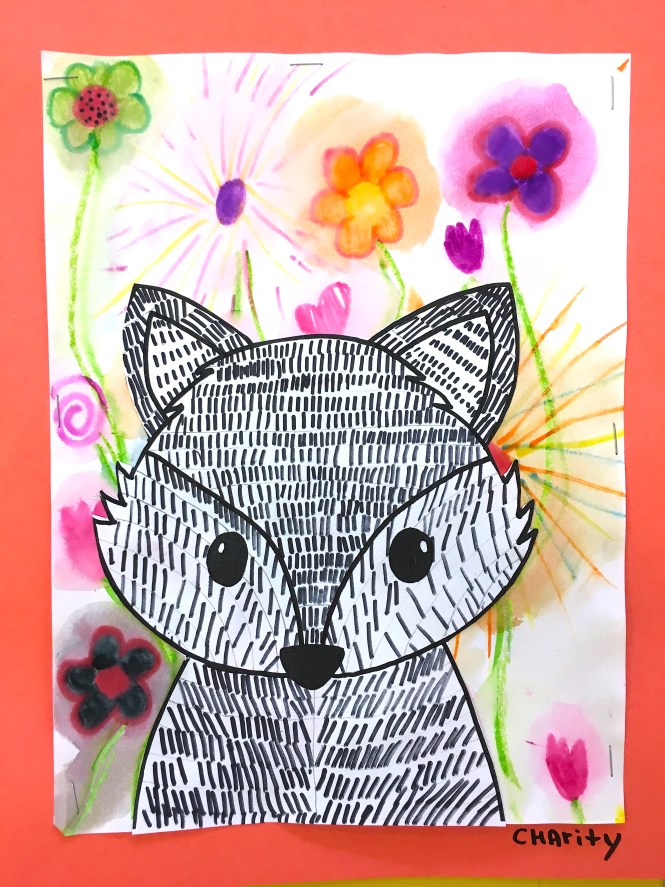
How adorable are these?!?
This lesson took (2) art classes to finish (and I had JUST enough time to squeeze in one more lesson before the end of the year)! It’s a simple one —but packs in a bunch! It incorporates the Elements of Art- Line, Shape, Color, Value and Texture! We also used overlapping, contrast and pattern in our work! Students could choose between creating a bunny, bear cub or fox.
Read below the photos of student’s artwork to see how they were created and how to get FREE bunny and bear templates!


The fox template was clearly the most adored by my 2nd graders!




DAY 1 – Creating the field of flowers background!
Students drew flowers all over their 9×12″ 80# drawing paper using markers and crayons. They were encouraged to draw the flower heads LARGE and draw LOTS!! Especially along the top and sides, since later on the animal would be placed over their painting in the center.
I demonstrated a bunch of different ways to create the flowers first, but students could draw them any way they wanted! I also encouraged them to use bright colors.
Once their paper was filled, they drew green stems from each flower head going all the way to the bottom, using a green crayon as well as a green marker for each one.
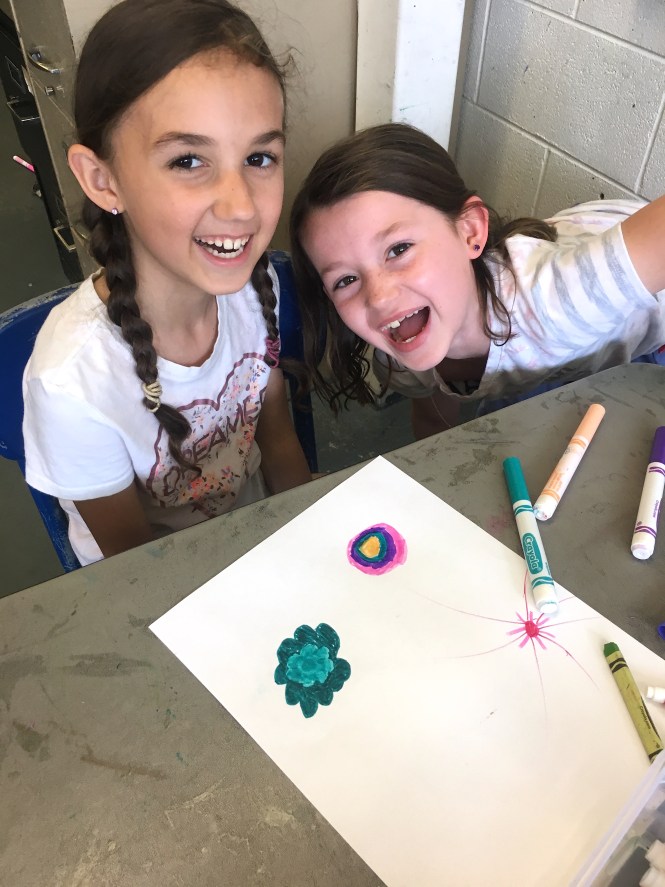


Once all the flowers and stems were drawn, using just water on a paintbrush, they went over each flower with water. This turns the marker into almost a watercolor consistency. I showed them how to just do one flower at a time then rinse their brush before moving onto the next so the colors wouldn’t get muddy.
Then students went over all their stems with water. The crayon part of the stems would remain a solid line since crayons resist water. We talked about the Element of Art “Value” and how the colors of the flowers would get softer and lighter in value once water was applied.


DAY 2 – Adding the animal!
Students chose a bunny, bear OR fox template to start drawing lines with sharpie to add TEXTURE!


I downloaded and photocopied the free bunny template from a website called Teachstarter found HERE . I created the bear one myself and made copies for kids, which you can get for free on my Teachers Pay Teachers page HERE. The fox template was created by an art teacher (Mrs. Bohn from McLeansville Elementary Art, via Instagram) who shared her fox drawing template with me!
I demonstrated how to draw straight and diagonal lines close together in between each section using sharpie. Students could leave the eye area as it was, or go over the bunny lashes and create longer lines. We discussed how the lines created fur- like TEXTURE. We also discussed how the black & white vs. the colorful flower background would create CONTRAST.
Once all the lines were drawn, students carefully cut out their animals and glued onto their flower background with a glue stick!
I just LOVE how simple yet beautiful this lesson is! Plus, kids continue to understand how they are applying the elements of art while creating!


Thank you for stopping by! To view other grade level artwork, click on the drop down menu on the main page, and select a grade to view more student art!
I will be posting again next week on 5th Grade “Grid Drawings” inspired by artist Chuck Close, and 4th Grade “Enlarged Flower drawings” inspired by artist Georgia O’Keeffe!
Be sure to check back soon!
Dandelion Puffs – 4th Grade

Additional artwork below!!
This easy and fun 2 day art lesson focused on the elements of art; Line, Shape, Color and Value. Students also learned about a new watercolor resist technique using rubber cement before painting!
Special shout out to artroombritt.blogspot.com for this lesson idea!
DAY 1
Students observed various drawings of dandelions and reviewed the meaning of composition in artwork, (composition= the way things are laid out or where things are drawn/placed on paper).


Students drew three stems spaced apart a bit coming from one side of a sheet of 9×12″ tagboard with pencil. They could be drawn coming from either side of the paper going towards the middle.
They drew a small circle at the tip of each stem for the dandelions center and then lightly drew a large circle around it to act as a guideline to where their dandelion seed heads would be drawn to, to create a full, fluffy dandelion puff.
Students drew 1 large dandelion and 2 smaller ones on either side of the large one. Then drew a variety of seed heads stemming out from the center of each dandelion. I demonstrated various seed head tips for drawing before students drew on their own papers. I also offered a handout to refer to and observe, if they wanted while drawing.


Then once all three were drawn, they added drifting seed heads blowing away from the dandelion puffs in the wind. These drifting seed heads were drawn traveling in different directions (just like in real life) and not only adds interest, but creates a nice composition with the three dandelions along the opposite side.
Then students went over their stems lines and dandelion puffs lines and drifting seed heads with a black sharpie. After using sharpie they erased any pencil lines that remained.


Once that was done, after class, (when students were no longer in my art room), I brushed on a thick layer of rubber cement where each circular dandelion puff would be, as well as on the drifting seed heads. The rubber cement was a bit stinky and isn’t healthy to breathe in, so I worked next to an open window. This is why I applied the rubber cement and not the students.
The rubber cement was left to dry until the next class. (BTW- This doesn’t take up much rubber cement at all- I used about 3 small jars for 4 classes (roughly 24 students per class).

DAY 2
Before applying paint to our drawings, we reviewed warm and cool colors.
I had ice cube trays filled with liquid watercolors (one end with warm colors (warm colors=reds, pinks, oranges and yellows) and the other end with cool colors (cool colors= blues, greens and purples).
We also reviewed the wet-on-wet watercolor technique before painting. After demonstrating, students applied water only to 1/2 their paper quickly with a watercolor brush. THEN applied dabs of either just warm colored paint OR just cool colored paint onto the wet areas using one color at a time.
Students noticed how the paint spread outward from where they dabbed little bits of paint over the watered down paper. The water helps spread the paint and it also changes the value of the color making the color lighter and less vibrant (value= the lightness or darkness of a color).


Then once one 1/2 of their paper was painted, they dabbed the painted section with a paper towel while still wet, to help soften the color and spread the paint even more.


Then painted the other 1/2 of their paper with water only and applied paint to that wet area then dabbed off with a paper towel.


Once paintings were dry, the rubber cement was rubbed off, revealing the white dandelion puffs!


Thanks for visiting my blog!! Check back soon for new 1st grade artwork! Next week!
Birch Tree Landscapes- 2nd Grade
This art lesson took about ( 3) 40 minute art classes to complete. Students learned about foreground, middle ground and background and how it creates a sense of space in artwork.
Read more below students artwork to find out how they were created!


DAY 1 – Creating the birch trees
After introducing foreground, middle ground and background to students, showing them multiple student artwork examples from previous years, and demonstrating the steps for day 1 of the lesson, students got to work creating their birch trees. We used 12 x 18″ medium weight tagboard for the paper.
Students drew 1 large tree in the foreground (area closest to the viewer- with objects drawn LARGEST along the bottom of the paper to show this) going all the way to the top of their paper.
Then drew a land line in the middle ground –(area in artwork that is placed in the middle of the paper or canvas, with objects drawn a bit smaller in this area, to show it is a bit further away from the viewer.) I demonstrated to make sure that they jumped over the tree as they drew the middle ground! Then proceeded to draw 2 slightly thinner trees from the middle ground up to the top of their paper.
Then they drew another hill / land line to show grass and trees growing in the background. This line was drawn near the top of the paper to show objects that are the furthest away from the viewer. Objects along this area are drawn the smallest to show they are the furthest things away in the artwork.
Once these areas were drawn with largest to smallest birch trees, going from the bottom of their paper to the top, students used a small piece of recycled currugated cardboard dipped into black paint to create the birch tree bark.


After creating the black lines for the birch bark in each tree, we created 1-2 branches for each tree by tilting the cardboard diagonally along the edges of our trees, and dragged the cardboard downward.
DAY 2 – Creating grass, flowers and painting the landscape
Students drew grass blades within their landscape using 2 different shades of green crayons and yellow. They pressed HARD as they drew the lines– It’s important to press hard not lightly here because the crayon bits would be painted over in the next step (creating a “crayon wax resist” technique with watercolors).
I showed kids how to hold all 3 crayons in one hand, drawing vertical and diagonal lines for the grass. (Doing this makes it easier and faster!) Some students held all 3 ok, and some preferred holding 2 then drawing the rest with the 3rd crayon after.
Then they drew a variety of flowers using crayons within each grassy section.


Once complete with grass and flowers, students painted the grass and sky with slightly watered down liquid watercolors! Creating a crayon wax resist.


DAY 3- ADDING THE WOODLAND ANIMALS TO THE LANDSCAPE!
Students referred to a variety of “step-by-step” how to draw animals that I had created and stapled together into packets to draw at least 1 animal to add to their landscapes.
Foxes, squirrels, owls, skunks, bunny’s, racoons, deer, and wild horses (which could OF COURSE be made into unicorns!) were in the packet.
Students chose 1-2 animals to draw, and used their observational drawing skills to draw them, color in with colored pencils, cut them out and glue onto their beautiful landscapes!


And there you have it!! Beautiful work everybody!!

5th Grade- Mixed-Media Bouquet of Flowers
This is a new lesson I started this year and I’m SO in love with them!! My 5th graders at Roosevelt just finished these yesterday and I couldn’t WAIT to post them to share!! Thank you Laura (Paintedpaperart.com) and amymcreynolds (Instagram) for the inspiration!
Finished artwork is 9×12″ with an 11 x 14″ white paper border hot glued to the back. Read more below to see how these beauties were created with steps and photos!


Here are some close ups!


This 4 day (four 40 min. art classes) lesson focuses on 6 of the 7 Elements of Art; Form, Line, Shape, Color, Texture, and Value.
We used white Modelite modeling material, printmaking with bubble wrap, splatter painting with watercolors, liquid tempera paints to paint the flowers, bubble wrap and flower’s stems and leaves, railroad board paper, 80# white drawing paper, and scissors and glue sticks to create these mixed-media flowers.
DAY 1
Students each received a small cut section of Modelite modeling material to make 5 flowers. This air hardening, super soft material is SO easy to manipulate and shape. If you’ve never used it, it’s very similar to ModelMagic. I found that (4) 8 ounce packages are more than enough for 1 class of about 25 students. I put each section in a plastic ziplock baggie ahead of time so they wouldn’t dry out and make passing out the materials for class easier. Then I just reuse the bags for the next class.


I demonstrated under the document camera ways to create a few different flowers, but students could make any kind they wanted.
Students rolled a small chunk of material into a small ball, about the size of a ping pong ball, then flattened the ball with their palm a bit (to about the thickness of an oreo cookie. Then used scissors to make cuts towards the center all the way around, then cut small triangle sections out from those cuts to separate and create the flowers petals. From there they used their fingers to shape and point the ends if they wanted, or leave them more straight on the ends. The leftover clay from the triangle cuts were balled up to make the flowers center. Other small balls of material were made into tulips, circle “button” flowers, and daisy’s and many other fun creative flowers! Kids got really creative! Take a look below!


Flowers were stashed away to dry until the next art class (I see each class once a week). To completely harden it takes 72 hours.
DAY 2
Students painted their flowers with liquid tempera paint. I put the paints in ice cube trays as seen below to separate colors. What a game changer!!! I had never thought of using these until THIS YEAR?!? Super cheap to buy at the Dollar Tree (pack of 2 for $1)!

Students could paint their flowers any colors they wanted! Kids started on the petals first, leaving the center last, in order to hold them down while painting. They rinsed their brush well in water and wiped on a paper towel between changing colors. Kids did a great job of keeping the colors clean! Trays were covered in tinfoil and stashed away until the next class.


Love all the colors, and layering of color! Flowers were left to dry until the next class!
DAY 3
Students created 2 different painted papers for their table and vase. First, they created a print using bubble wrap. They painted the bubble side with liquid tempera and could use any colors they wanted from the trays. Once painted, they laid a sheet of 80# drawing paper on top, rubbed their hands over the paper and then peeled the paper off revealing their print!


Even if the print produced some areas with less color, students could use other sections of their print to cut out and create their tables and vases.
After they printed, they did some fun splatter painting with watercolors on a separate sheet of 9×12″ paper. Kids LOVED this and had a blast!


Paintings were left to dry until the next class!
DAY 4
On the final day students assembled everything together! To prep, I hot glued all students 5 flowers onto a sheet of 9×12″ railroad board (like bristol board with both sides colored). Teachers out there reading, this took a bit of time (about 1 hour per class of 27 students). I picked out the color for the paper, and had 2 hot glue guns going as I worked, then wrote each students name on the bottom of the paper. After, I placed all their papers with flowers in a large cardboard mason box to disperse in class later.
I demonstrated to students under the doc camera to measure one of their selected painted papers using a ruler. They measured 4″ from the bottom of their 9×12″ sheet, making 3 marks. Then they draw a straight horizontal line using the ruler along those (3) 4″ marks. Then cut along the line and glue with a glue stick and apply to the bottom of their railboard paper to create the table.
Then they choose another section of painted paper to create their vase. I suggested they use both painted papers (one for the table and a different one for the vase) for more visual interest, but they could use the same paper if they really wanted.
I created 4 different vase example drawings and photocopied them on cardstock to use as either a visual aid to observe and draw from, cut out as a tracer then trace on their painted paper, or they could create their own vase entirely. I wanted to offer a variety of methods, and including a tracer was helpful, since getting the sizing right to fit the paper under their flowers might of been a bit tricky.


For a final step, students used 2 different shades of green liquid tempera to paint flower stems and leaves.


The student above, on the left discovered how cool the BACKSIDE of his splatter painting was and decided to use that side instead for his vase! And look at that gorgeous rose on the top right! Beautiful!


The student above wanted to outline her vase and add black details with oil pastel! LOVE LOVE LOVE! It reminds me of Matisse!
They all turned out so lovely! I love the variety of flowers, textures, colors AND unique artistic decisions!! I can’t wait to mount them all on white paper and display them in the halls!
Thanks so much for stopping by! Check back soon for more artwork by 2nd grade, 4th grade and 1st grade!!
PRINTMAKING –VASE OF FLOWERS!


Today in both my special needs classes we printed flowers using markers!
I drew the flowers in vases on styrofoam plates for each student ahead of time with a black sharpie.

Students then traced over the black lines with a dull colored pencil, pressing into the styrofoam. This creates an indentation in the surface of the styrofoam where ever it has been pressed in. With my help and the help of Para’s in each class, we assisted each student hand over hand. This is a great muscle strengthener and fine motor control building art activity for people of all ages and levels!


Once the black lines are traced entirely, students then colored in the flowers, leaves, and vase with washable markers. They could use any colors they wanted.

Once colored, I sprayed water, using a recycled spray cleaner bottle, 6 times on a sheet of 9×12″ 80# white drawing paper. Two sprays at the top, two in the middle, and two at the bottom. Then students helped wipe the paper with a pre-dampened sponge, to help spread the water over the paper evenly.
Then the styrofoam was placed color side down, over the damp paper, and students pressed using their hands to transfer the image from the styrofoam to their papers.
(Unfortunately, I wasn’t able to get a photo of these few steps)– then after pressing all over the back of the styrofoam, students used a brayer to roll over the back of the styrofoam to help further transfer their marker image.
Then the styrofoam was lifted off the dampened paper, revealing their wonderful flower print! I LOVE how they all turned out!!

It’s always so fun to show students a new art making process, and students loved it!!
To check out a more detailed description with additional photos on printmaking with markers, click on my 3rd grade art lessons page HERE and scroll down! My 3rd graders are all currently learning about printmaking with markers as well, and will be posting their “Complementary Creature Prints” soon!!
THANKS SO MUCH FOR STOPPING BY!!!
PLEASE CHECK BACK SOON FOR MORE AMAZING STUDENT ARTWORK!!!
SPRINGTIME BUNNIES AND BEAR CUBS- 2ND GRADE!
How adorable are these?!? My 2nd graders did such a fantastic job creating them!
This lesson took (3) 40 minute art classes to finish and incorporates the Elements of Art- Line, Shape, Color, Value and Texture! We also used overlapping, contrast and pattern in our work! Students could choose between creating a bunny or a bear cub. Read below the photos of students artwork to see how they were created!
Sorry, there are A LOT of photos!! I couldn’t help myself–they are ALL too cute!
TEACHERS – You can get a free downloadable BEAR CUB template on my TPT page HERE!


These are currently up on display!

I couldn’t decide which image to post –so I decided on showing both panoramic and regular!

DAY 1
Students drew flowers all over their 9×12″ 80# drawing paper using markers and crayons. They were encouraged to draw the flower heads LARGE and draw LOTS!! Especially along the top and sides since later on the bunny or bear would be placed over their painting.
I demonstrated a bunch of different ways to create the flowers first, but students could draw them any way they wanted! I also encouraged them to use bright colors. If they drew flower heads with a circle center, they colored in the circles with crayon, pressing hard. Once their paper was filled they drew green stems from each flower head going all the way to the bottom, using a green crayon as well as a green marker for each one. 


DAY 2
Students finished up creating their flower heads and stems if needed (they really took their time with this step and loved created intricate flowers!!) then using just water on a paintbrush, they went over each flower with water.
This turns the marker into almost a watercolor consistency, which kids LOVED!! I showed them how to just do one flower at a time then rinse their brush before moving onto the next so the colors wouldn’t get muddy.
Then students went over all their stems with water. The crayon part of the stems would remain a solid line since crayons resist water.


We talked about the Element of Art “Value” and how the colors of the flowers would get softer and lighter in value once water was applied.


I absolutely LOVE this flower painting below!! Particularly the way the yellow flowers came out! So lovely!!

The wet flower paintings were left to dry until the following class. Students then either chose a bunny or bear cub template to start drawing lines with sharpie to add TEXTURE!
I downloaded and printed the bunny template from a website for teachers called Teachstarter (free template) and then created the bear one myself and made copies for kids.


I demonstrated how to draw straight lines close together in between each section using sharpie. Students could leave the eye area as it was, or go over the lashes and create longer lines. We discussed how the lines created fur- like texture. We also discussed how the black & white vs. the colorful flower background would create CONTRAST.


DAYS 2-3
Students continued drawing lines if needed, then carefully cut out their animals and glued onto their flower background! I just LOVE how simple yet beautiful this lesson is! Plus- kids continue to understand how they are applying the elements of art while creating!


